
China officially established its first national park system in October 2021 with five flagship parks spanning 230,000 square kilometers, and among the 11 parks you can visit today (including official designations and standout pilot sites), the best are Sanjiangyuan National Park, Giant Panda National Park, Northeast China Tiger and Leopard National Park, Wuyishan National Park, Hainan Tropical Rainforest National Park, Zhangjiajie National Forest Park, and Jiuzhaigou Valley. These seven represent a groundbreaking conservation effort that began in 2012 and culminated in a model that rivals the world’s best adventure parks for biodiversity and wild terrain.
If you’re accustomed to the American national park model, China’s approach is different. The country launched 10 pilot parks in 2015 to test conservation strategies before rolling out the official system. The result blends ecological protection with limited but growing visitor access, meaning some parks welcome travelers now while others remain restricted or phased. Interest in these parks has surged 60% as travelers seek alternatives to crowded heritage sites and as China opens doors to nature tourism.
What makes these parks remarkable isn’t just their size or scenery. Sanjiangyuan protects the source of the Yangtze, Yellow, and Mekong rivers. Giant Panda National Park connects fragmented habitats to save an icon. Zhangjiajie and Jiuzhaigou deliver landscapes so surreal they’ve inspired films and folklore. Whether you’re planning a trip or simply curious about this emerging system, the parks ranked below balance accessibility, natural wonder, and the chance to witness conservation in action across one of the planet’s most biodiverse nations.
How We Ranked China’s National Parks
Ranking China’s national parks requires navigating a unique landscape where ecological ambition meets practical tourism realities. In 2021, China officially established its first five national parks after years of pilot projects, but the story doesn’t end there. Many protected areas that travelers recognize, places that shaped international perceptions of China’s natural beauty, exist outside this official framework as forest parks, nature reserves, or pilot sites from the 2015 trial program.
We evaluated parks against criteria that matter most to adventure travelers planning actual visits:
- Visitor accessibility for international tourists, including permit processes and tour infrastructure
- Natural diversity and unique ecosystems that can’t be experienced elsewhere
- Wildlife viewing opportunities, especially for rare or endangered species
- Tourism infrastructure balancing conservation with practical visitor needs
- Official designation status within China’s 2021 national park system
This ranking includes the five officially designated parks from 2021, Sanjiangyuan, Giant Panda, Northeast China Tiger and Leopard, Wuyishan, and Hainan Tropical Rainforest, which collectively protect 230,000 square kilometers. We’ve also included two parks outside the official five that remain essential to understanding China’s protected landscape. Zhangjiajie and Jiuzhaigou, while technically forest parks, participated in the 2015 pilot program that shaped the current system and continue to draw millions seeking China’s most dramatic scenery.
Think of it this way: the official five represent China’s conservation future, while the pilot parks reflect the journey that got them there. Both categories offer legitimate national park experiences, just under different administrative frameworks. The rankings reflect which parks deliver the most compelling combination of wilderness, accessibility, and that intangible sense of standing somewhere truly wild.
1. Sanjiangyuan National Park, Qinghai, The Source of Asia’s Great Rivers
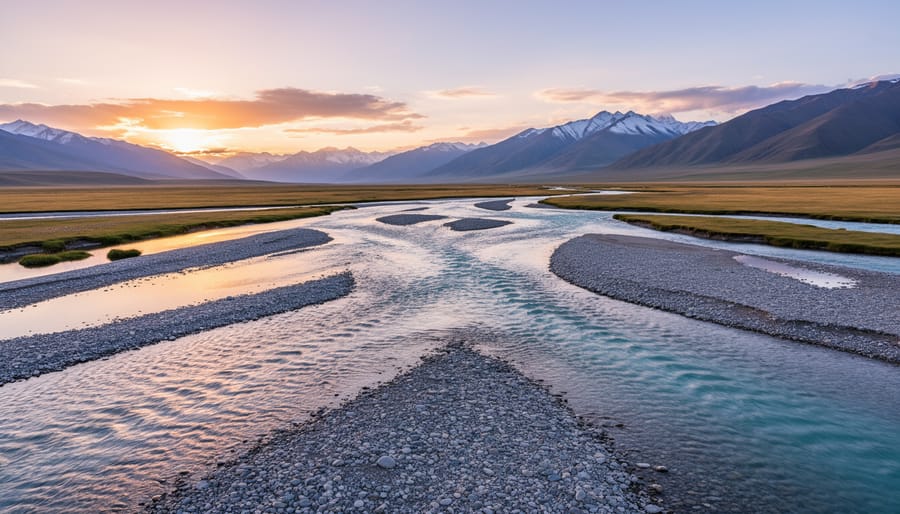
Sanjiangyuan takes the top spot not because it’s easy to visit, it isn’t, but because it represents the absolute pinnacle of China’s conservation ambitions. Officially designated in October 2021 as one of the first five national parks, this 190,700 square kilometer expanse across the Qinghai-Tibet Plateau protects something irreplaceable: the birthplace of Asia’s three mightiest rivers.
Stand at the headwaters of the Yangtze, Yellow, and Mekong here, and you’re witnessing the source of water for billions of people downstream. The name itself translates to “Three-River-Source,” a straightforward descriptor for a landscape that defies simple explanation. This is the world’s highest large wetland, a vast patchwork of alpine meadows, glacial lakes, and snow-capped peaks averaging over 4,000 meters in elevation.
The wildlife here has adapted to conditions that would devastate most species. Snow leopards hunt blue sheep across ridgelines, though spotting one requires patience and serious luck. Tibetan antelope migrate across the plateau in herds that can number in the thousands, their white rumps flashing against rust-colored grasslands. You might see Tibetan wild ass, black-necked cranes, and if you’re extraordinarily fortunate, a brown bear lumbering across a distant slope.
The park’s sheer scale dwarfs most protected areas on Earth. At nearly 74,000 square miles, it’s larger than all of Colorado’s national parks combined, a comparison that puts its conservation significance in perspective. China designated this as a national park specifically to address decades of overgrazing and climate impacts that were threatening these critical headwaters.
Visiting demands serious preparation. The altitude alone will flatten unprepared travelers, and infrastructure remains minimal by design. Most visitors join guided expeditions that operate during summer months when roads are passable. This isn’t a park you casually drop into, it’s a pilgrimage to one of the planet’s last truly wild places.
2. Giant Panda National Park, Sichuan, Where the Icon Roams Wild

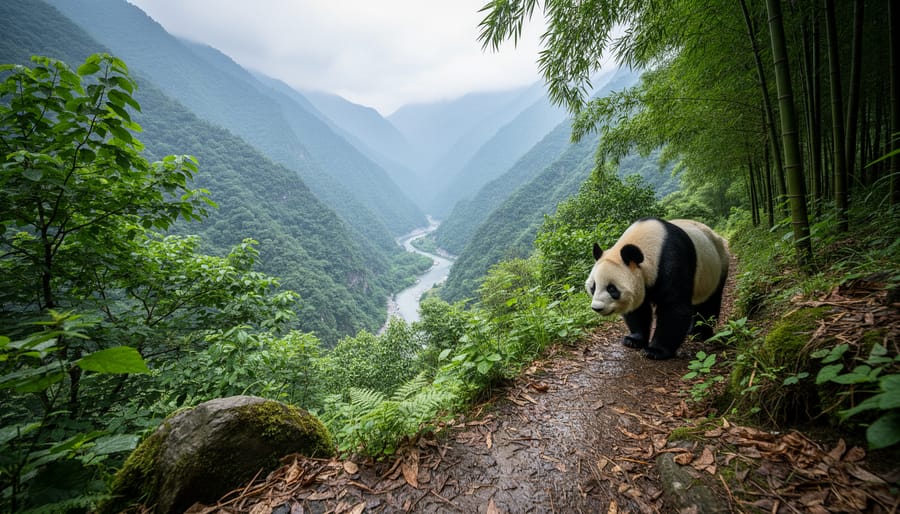
Giant Panda National Park sprawls across 27,000 square kilometers of mountainous terrain in Sichuan, Shaanxi, and Gansu provinces, making it roughly the size of Massachusetts. Established as one of China’s first five official national parks in 2021, it protects more than 80% of the remaining wild giant panda population, approximately 1,800 individuals roaming bamboo forests at elevations between 1,200 and 3,700 meters.
The park’s creation unified 67 previously separate panda reserves, nature reserves, and forest parks into a single protected corridor. This consolidation addresses a critical challenge: habitat fragmentation. By connecting isolated panda populations, the park allows genetic diversity to flow between groups that had been cut off from each other for decades. The result is a conservation blueprint that goes beyond protecting individual reserves to safeguarding an entire ecosystem.
What you won’t find here is a zoo-like experience. Unlike the breeding centers in Chengdu where visitors queue for panda selfies, the national park prioritizes wilderness protection over tourism access. Most of the core habitat zones remain completely off-limits to visitors. The park operates a strict permit system, and many areas require advance approval that can take months to secure.
That said, designated visitor centers and research stations on the park’s periphery offer legitimate access points. You can hike marked trails through bamboo groves, visit research facilities where scientists monitor wild populations, and explore buffer zones where pandas occasionally wander. Spring brings wildflowers across the mountain slopes, while autumn paints the mixed forests in reds and golds. The dry season from October through April provides the best trekking conditions, though wildlife sightings remain rare, pandas are elusive even in their stronghold.
Expect basic infrastructure in most areas. This isn’t a park designed for convenience; it’s built for conservation first, with human visitors a distant consideration.
3. Northeast China Tiger and Leopard National Park, Predators on the Comeback

Straddling the border between northeastern China and Russia, Northeast China Tiger and Leopard National Park stands as one of the five parks officially designated when China’s national park system launched in 2021. This isn’t a park where you’ll find scenic overlooks and gift shops at every turn. It was created for one primary purpose: bringing the world’s most endangered big cats back from the brink.
The park protects the last remaining habitat for wild Amur tigers and Amur leopards in China, species that had nearly vanished from the region by the 1990s. Today, thanks to aggressive anti-poaching efforts and habitat restoration, around 50 tigers and 60 leopards roam these forests, up from single digits two decades ago. The numbers remain critically low, but the trajectory offers hope that wildlife corridors can work even for apex predators requiring massive territories.
What sets this park apart is its cutting-edge monitoring system. Thousands of motion-triggered cameras blanket the forest, using AI to identify individual animals by their stripe and spot patterns. The data feeds real-time alerts to rangers and researchers, creating what some call the most sophisticated wildlife surveillance network in Asia. For visitors, this technology translates to occasional viewing opportunities at designated monitoring stations, though sightings remain rare and unpredictable.
Tourism here looks nothing like Yellowstone or Rocky Mountain National Park. Access is tightly controlled, with most areas completely off-limits to protect breeding populations. Small groups can join guided expeditions along approved routes, tracking paw prints in snow, examining scratch marks on trees, and learning how camera traps document elusive predators. You probably won’t see a tiger, but you’ll experience a wilderness managed for wildlife first and visitors second, a model that feels both humbling and thrilling for those willing to embrace the uncertainty.
4. Wuyishan National Park, Fujian, Ancient Forests and Cultural Heritage
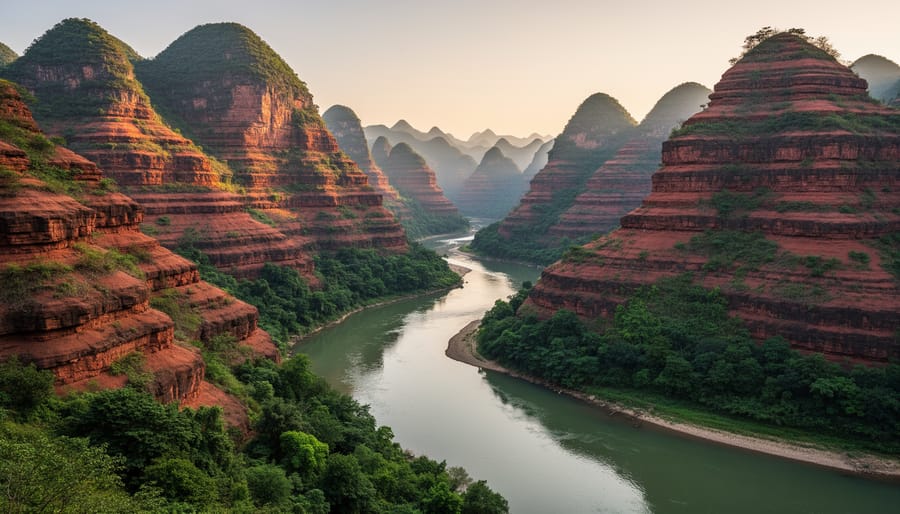
Wuyishan stands apart as the only officially designated national park that doubled as a UNESCO World Heritage site before 2021, recognized for both its exceptional biodiversity and as a living record of Neo-Confucianism. Tucked into the border mountains between Fujian and Jiangxi provinces, this 1,280-square-kilometer park protects one of the most intact subtropical forests in eastern China, where over 5,000 wildlife species share space with terraced tea gardens that have been cultivated for nearly two millennia.
The park’s signature feature is its rust-red Danxia landforms, sheer cliffs and pillared peaks sculpted from layered sandstone that glow amber at sunrise. The Nine Bend River cuts through these formations in sweeping curves, and a bamboo raft drift down this waterway remains the classic way to experience Wuyishan. You’ll glide past rock walls where ancient coffins rest in cliff-side caves and through mist-shrouded gorges where macaques watch from the canopy.
What makes Wuyishan particularly fascinating is how it manages to honor both wilderness and human heritage. The park encompasses Buddhist temples and Taoist grottoes carved into mountainsides, plus the remnants of academies where scholars once debated philosophy. The surrounding buffer zones still produce some of China’s most prized oolong teas, especially the smoky Lapsang Souchong and the complex Da Hong Pao grown from ancient bushes clinging to rock faces.
This dual mandate, protecting wild ecosystems while celebrating cultural landscapes, reflects China’s broader approach to its national park system. Unlike parks designed purely as wilderness preserves, Wuyishan acknowledges that humans have shaped these mountains for thousands of years, and that heritage is worth protecting alongside the clouded leopards and Chinese giant salamanders that inhabit its streams.
5. Hainan Tropical Rainforest National Park, China’s Amazon
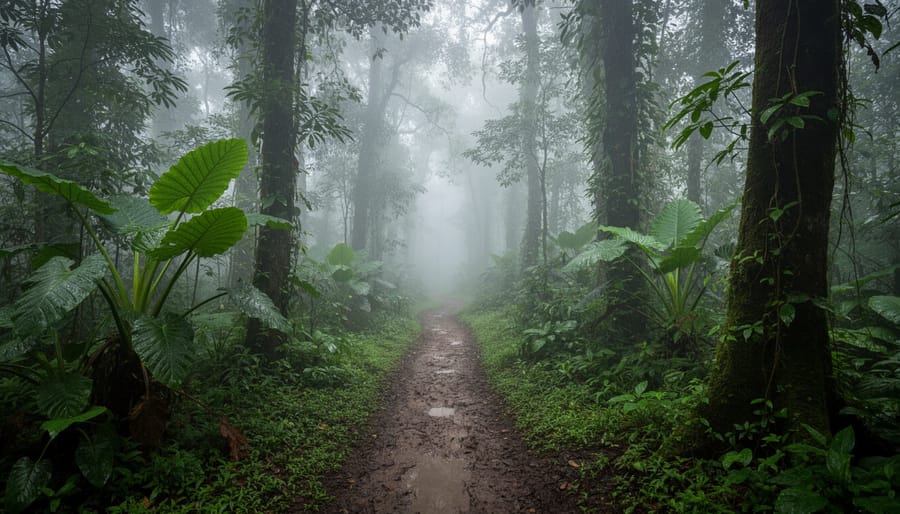
Hainan Tropical Rainforest sprawls across the mountainous heart of China’s southernmost island, protecting the last significant expanse of tropical rainforest on Chinese soil. Officially designated in 2021 as one of the country’s five national parks, this 4,269-square-kilometer reserve shelters ecosystems found nowhere else in the nation. The park’s elevation ranges from lowland valleys to 1,867-meter peaks, creating microclimates that support an astonishing 3,653 species of vascular plants and hundreds of endemic animals.
The star resident is the Hainan gibbon, one of the world’s rarest primates with fewer than 40 individuals remaining. These black-furred apes swing through the canopy in small family groups, their haunting songs echoing at dawn. The park also hosts clouded leopards, Hainan flying squirrels, and over 360 bird species. Towering dipterocarp trees form the canopy, while strangler figs, wild orchids, and ancient cycads fill the understory with a green intensity that rivals any South American rainforest.
What sets this park apart is accessibility. Unlike remote mainland reserves, Hainan Tropical Rainforest sits within striking distance of beach resort towns along the island’s coast. You can go from oceanfront hotels in Sanya to misty mountain trails in under two hours. Multiple entrance points offer boardwalk hikes, canopy walkways, and guided treks ranging from family-friendly strolls to multi-day expeditions. The humid heat is intense year-round, but the monsoon season from May through October brings the forest to its most vibrant, dripping life.
For Colorado adventurers accustomed to alpine ecosystems, this park delivers a completely different experience: dense, humid, alive with sounds you can’t identify and green in every direction you look.
6. Zhangjiajie National Forest Park, Avatar’s Inspiration
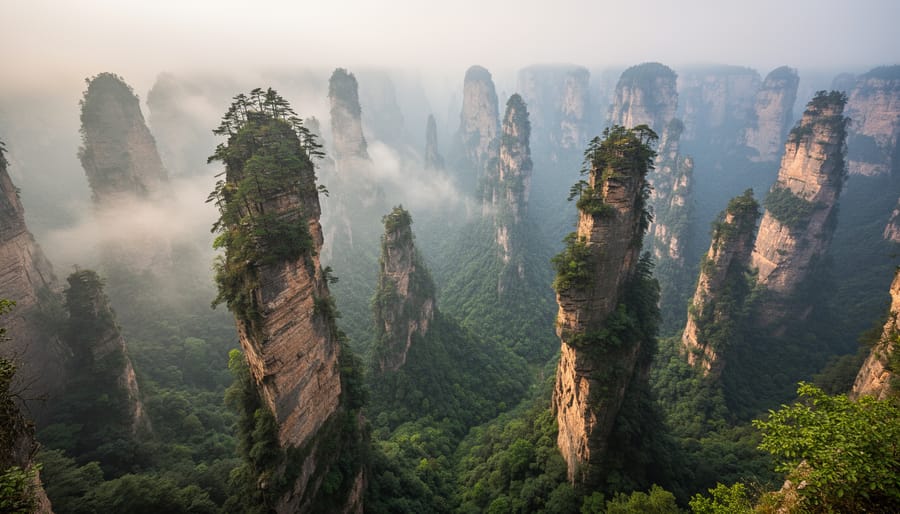
Zhangjiajie earned global fame when James Cameron’s team visited in 2008, and the park’s otherworldly quartzite sandstone pillars became the floating Hallelujah Mountains in Avatar. But this wasn’t a newly discovered gem, Zhangjiajie has drawn visitors since becoming China’s first national forest park in 1982 and gaining UNESCO World Heritage status in 1992 as part of the Wulingyuan Scenic Area.
Here’s the key distinction: Zhangjiajie is a national forest park, not one of the five officially designated national parks established in 2021. However, it earned a spot in China’s 2015 pilot system for the national park network, testing conservation and tourism management approaches that would inform the final framework. That pilot role, combined with its UNESCO recognition and status as one of China’s most accessible protected landscapes, makes it impossible to ignore in any ranking of the country’s must-visit natural areas.
The park’s signature feature is the vertical landscape. More than 3,000 quartzite sandstone pillars rise up to 200 meters from the forest floor, many topped with precariously balanced trees and shrouded in mist. The Southern Sky Column, renamed Avatar Hallelujah Mountain after the film’s release, stands as the most photographed pillar. Walk the Golden Whip Stream trail at ground level for an intimate perspective, or take the Bailong Elevator, a glass lift carved into a cliff face, to reach the upper plateaus in under two minutes.
The Zhangjiajie Glass Bridge, spanning 430 meters across Zhangjiajie Grand Canyon, opened in 2016 and quickly became a draw in its own right. Walking 300 meters above the canyon floor offers vertigo-inducing views, though crowds can be intense during peak season.
What sets Zhangjiajie apart from the remote official parks is accessibility. The infrastructure rivals any major tourist destination, with cable cars, walkways, and tour services that make the dramatic scenery available to travelers of all fitness levels.
7. Jiuzhaigou Valley, The Fairyland of Colorful Lakes
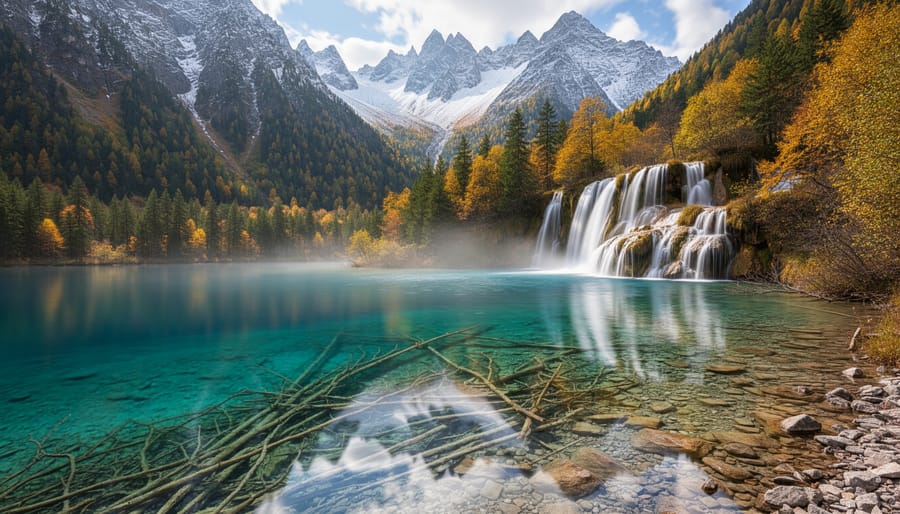
Jiuzhaigou Valley sits in the mountains of northern Sichuan at elevations ranging from 2,000 to 4,500 meters, and the moment you see those electric-blue and turquoise lakes, you understand why locals call it a fairyland. The park’s 118 lakes formed in karst valleys, fed by glacial meltwater that picks up minerals creating water so clear and colorful it doesn’t look real. Five Flower Lake shifts between sapphire, emerald, and jade depending on the angle of sunlight and the limestone deposits below.
This was one of China’s original ten pilot parks launched in December 2015, though it didn’t make the official five designated in 2021. That doesn’t diminish its status as a UNESCO World Heritage Site or its position as one of China’s most spectacular protected areas. The valley is home to nine Tibetan villages (Jiuzhaigou translates to “Nine Village Valley”), and you’ll see prayer flags, wooden houses, and yak herders alongside the natural wonders.
The park faced a severe test in August 2017 when a 7.0 magnitude earthquake triggered landslides and damaged trails and infrastructure. Recovery efforts prioritized ecological restoration over rapid reopening, and the park now limits daily visitors to protect both the recovering landscape and the fragile travertine formations that create those cascading waterfalls.
Autumn transforms Jiuzhaigou into a kaleidoscope when birch and maple forests explode in gold and crimson against the blue lakes. Winter brings a quieter beauty with frozen waterfalls and snow-dusted peaks, though temperatures drop well below freezing. The seasonal shifts make this a park worth visiting more than once, and anyone who’s followed visitor planning tips for high-altitude destinations knows that acclimatization matters here. The mountain roads require attention to driving safety outdoors especially during winter conditions or after heavy rains.
What Makes China’s National Parks Different
China’s national park system represents one of the most ambitious conservation initiatives in modern history, and it works fundamentally differently than the US national parks model most travelers know. The journey started in 2012 when China began promoting a unified national park-based nature reserve system. By 2015, the government launched 10 pilot parks to test management approaches, and on October 12, 2021, President Xi Jinping officially established the first batch of five national parks covering 230,000 square kilometers.
The philosophy behind China’s approach flips the traditional script. Where American parks balance preservation with visitor experience, China’s system puts ecological integrity front and center. Tourism infrastructure exists, but it’s deliberately limited to minimize human impact on fragile ecosystems. This means you won’t find the extensive trail networks, lodges, and facilities common in Colorado’s protected areas. Instead, many zones remain strictly off-limits, with carefully controlled access to viewing areas.
The scale matters globally. That 230,000 square kilometers protects critical habitat for endangered species like giant pandas, snow leopards, Amur tigers, and Hainan gibbons. It’s a continental-level conservation effort that connects previously fragmented protected areas into unified ecosystems. The pilot parks from 2015, including Zhangjiajie and Jiuzhaigou, helped refine this model before the official 2021 launch. For adventurous travelers, this means experiencing some of Earth’s wildest places in their most pristine state, though it requires more planning and flexibility than a typical national park trip.
Planning Your Visit: What You Need to Know
Visiting China’s national parks requires more preparation than a typical trip to U.S. parks, but the effort pays off with once-in-a-lifetime experiences. Most parks require advance permits, and international visitors often need to arrange these through licensed tour operators rather than booking independently. This isn’t a barrier, it’s an opportunity to travel with guides who know the terrain, speak the local languages, and understand the conservation protocols these parks enforce.
Timing matters significantly. Spring (April through June) and autumn (September through October) offer the best conditions across most parks, with moderate temperatures and lower rainfall. Summer brings heavy tourist crowds to accessible parks like Zhangjiajie and Jiuzhaigou, while winter closes high-altitude areas entirely. For wildlife viewing in Giant Panda National Park or Northeast China Tiger and Leopard National Park, patience and realistic expectations are essential, these are wild spaces, not zoos.
Pack layers for dramatic temperature swings, especially in mountainous regions. Respect local customs in parks with indigenous communities, particularly Tibetan areas in Sanjiangyuan and Jiuzhaigou. Stay on designated trails, follow leave-no-trace principles, and remember that these parks prioritize conservation over visitor convenience. The regulations exist to protect ecosystems that took millennia to develop and that China committed to preserving when it established the official system in 2021.
Frequently Asked Questions
How many national parks does China officially have?
China officially established five national parks in October 2021, covering 230,000 square kilometers. The system grew from a pilot program that began in 2015 with ten pilot parks, and the government continues expanding the network as part of its long-term conservation vision.
Can foreign tourists visit China’s national parks?
Yes, foreigners can visit most of China’s national parks, though accessibility varies widely. Parks like Zhangjiajie and Jiuzhaigou have well-developed tourism infrastructure and welcome international visitors, while remote parks like Sanjiangyuan require special permits and guided tours due to their fragile ecosystems and high-altitude locations.
What’s the difference between China’s national parks and forest parks?
National parks prioritize ecological protection and wildlife conservation with limited human activity, similar to the U.S. model but more restrictive. Forest parks, by contrast, allow more development and recreational activities. Both Zhangjiajie and Jiuzhaigou started as forest parks or scenic areas before joining the national park pilot system.
When is the best time to visit China’s national parks?
Spring and autumn offer the most comfortable conditions for most parks, with mild temperatures and stunning seasonal colors. Summer brings monsoon rains to southern parks but opens access to high-altitude parks like Sanjiangyuan, while winter closes many mountain areas but offers snow-draped landscapes in accessible locations like Zhangjiajie.
Understanding these fundamentals helps you plan a realistic trip to China’s protected landscapes. The national park system remains young compared to established programs in the U.S. or Canada, which means you’ll encounter a mix of world-class conservation efforts and evolving visitor infrastructure. Some parks balance tourism and protection more successfully than others, and regulations can shift as managers refine their approach to sustainable access.
The comparison to American national parks reveals both similarities and differences. Like the U.S. system, China’s parks protect iconic wildlife and landscapes while allowing controlled visitation. However, China’s emphasis leans harder toward ecological restoration and species recovery, sometimes at the expense of visitor access. Where Yellowstone might accommodate millions of annual visitors, parks like Northeast China Tiger and Leopard National Park restrict human presence to give critically endangered predators room to recover. That conservation-first philosophy reflects both China’s biodiversity crisis and its commitment to reversing decades of habitat loss.
China’s national park system stands as one of the most ambitious conservation initiatives on the planet. Since its official establishment in 2021, this network has protected 230,000 square kilometers of irreplaceable ecosystems, from the Tibetan plateau’s river sources to tropical rainforests sheltering the world’s rarest primates. The five officially designated parks, joined by iconic protected areas from the 2015 pilot program, offer adventure travelers landscapes and wildlife encounters unlike anywhere else on Earth.
What makes this system remarkable isn’t just its scale. It’s the speed and determination behind it. China began promoting a national park-based nature reserve system in 2012, launched pilot parks in 2015, and formalized the entire framework within a decade. That pace signals a commitment to conservation that matches the country’s economic ambitions.
For those of us who find renewal in wild places, these parks represent a frontier. Just as Colorado’s high country and canyonlands anchor our adventures here, China is creating continental-scale sanctuaries for species and experiences you can’t find anywhere else. The system will expand, the infrastructure will evolve, and the stories emerging from these landscapes will only grow richer.
If bucket-list wilderness is your calling, don’t wait decades to discover what China is protecting now. These seven parks offer once-in-a-lifetime journeys today, and the system’s best chapters are still being written.