
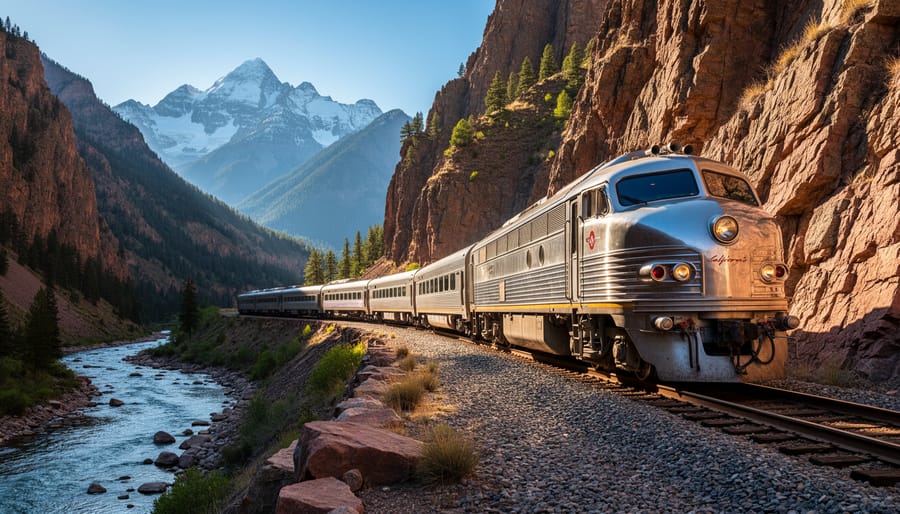
The California Zephyr through Colorado, particularly the stretch between Denver and Glenwood Springs, claims the title as Amtrak’s most scenic route. This 234-mile segment slices through the heart of the Rockies, hugging canyon walls above the Colorado River and threading through landscapes that highway travelers simply can’t access.
If you’re planning your 2026 adventure, you’re not just choosing a train ride. You’re booking a front-row seat to some of the most dramatic terrain in the American West. The Zephyr passes through 28 tunnels, crosses the Continental Divide at Moffat Tunnel, and descends into canyons where bighorn sheep outnumber people. On clear days, you’ll catch views of 14,000-foot peaks from the comfort of panoramic windows.
But here’s what most travel guides won’t tell you: the “most scenic” label depends on what moves you. While the Zephyr dominates rankings for sheer mountain drama, other Amtrak routes offer their own visual rewards. The Coast Starlight serves up Pacific sunsets. The Empire Builder crosses Montana’s glacier country. Each route delivers a different flavor of American landscape.
This guide ranks the top scenic Amtrak routes based on viewshed diversity, terrain exclusivity (what you can’t see from a car), and seasonal consistency. We’ll break down exactly which segments shine brightest, the best seats to book, and how to time your journey for optimal light. Whether you’re a Colorado local exploring regional options or planning a cross-country rail adventure, you’ll leave with a clear answer to which route deserves your time and ticket dollars.
How We Ranked Colorado’s Most Scenic Amtrak Routes
Ranking train routes isn’t just about pretty views from a window. We wanted to capture what makes a journey truly memorable for Colorado visitors, whether you’re a solo photographer chasing that perfect canyon shot or a family looking for an easy introduction to mountain travel.
Our evaluation focused on five core criteria:
- Scenic diversity, how many distinct Colorado landscapes you’ll see, from alpine forests to red rock canyons to river valleys
- Landmark visibility, access to iconic features like the Continental Divide, Glenwood Canyon, or Spanish Peaks that define Colorado’s character
- Seasonal viewing quality, whether routes deliver year-round beauty or peak during specific months
- Accessibility and comfort, how easily different travelers (families, seniors, first-timers) can enjoy each route
- Unique perspective, what you can only see from the train, not from highways or hiking trails
We also gathered firsthand accounts from Nomadic Adventures community members who’ve ridden these routes across different seasons. Local guest contributors shared their favorite viewing spots and timing tips. This isn’t just guidebook research, it’s built on real experiences from people who know Colorado’s backcountry and understand what makes a train journey worth taking. The rankings reflect both objective scenic factors and the subjective magic that makes certain segments unforgettable.
1. California Zephyr: Denver to Glenwood Springs, Colorado’s Crown Jewel
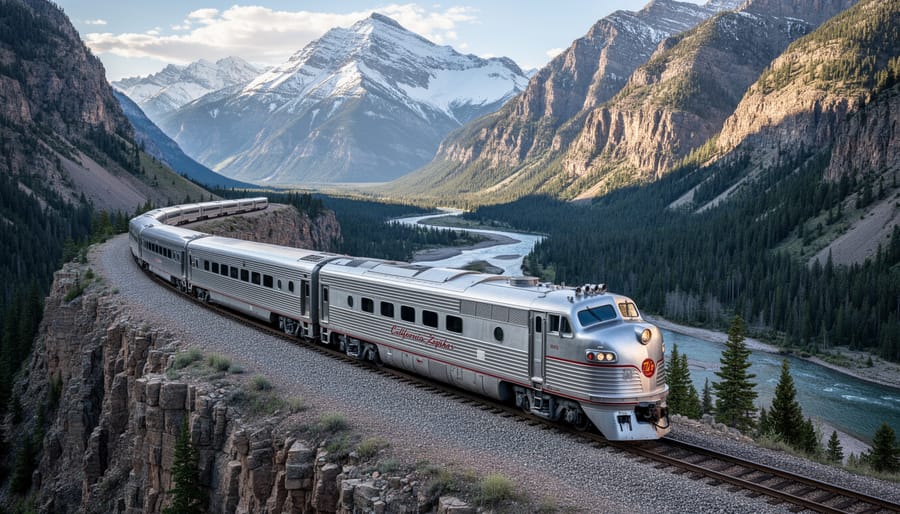
The Denver to Glenwood Springs stretch of the California Zephyr delivers a relentless three-hour showcase of Colorado’s most dramatic alpine terrain, earning its reputation as the state’s most scenic train journey. This 174-mile segment climbs into the heart of the Rockies, threading through engineering marvels and untouched wilderness that Highway 70 drivers can only glimpse from a distance.
Your adventure begins the moment the train departs Denver’s Union Station, heading west toward the Front Range. Within 30 minutes, you’re ascending into the foothills, and by the time you reach the town of Fraser, the landscape has transformed completely. The real spectacle kicks off at the Moffat Tunnel, a 6.2-mile bore punched through the Continental Divide at 9,239 feet. You’ll spend about six minutes in darkness before emerging on the western slope, where the Colorado Rockies unfold in full glory.
Between Winter Park and Glenwood Springs, the train hugs the Colorado River through Gore Canyon, where sheer granite walls rise hundreds of feet on both sides. This section is accessible only by rail or raft, making it one of Colorado’s most exclusive scenic experiences. You’ll spot kayakers navigating Class IV rapids, bighorn sheep perched on impossible ledges, and fishing guides working the river’s calmer stretches.
The route hits another high point passing through Glenwood Canyon, where sedimentary cliffs glow amber and rust in late afternoon light. Eagles nest in the canyon walls, and hot springs steam along the riverbank. Fall transforms the aspen groves into rivers of gold, while winter coats the canyon in pristine snow that contrasts sharply with the dark rock faces. One Nomadic Adventures community member described watching a sunset paint the canyon walls pink and orange as “the moment I understood why people never leave Colorado.”
2. California Zephyr: Glenwood Springs to Grand Junction, Red Rock Drama
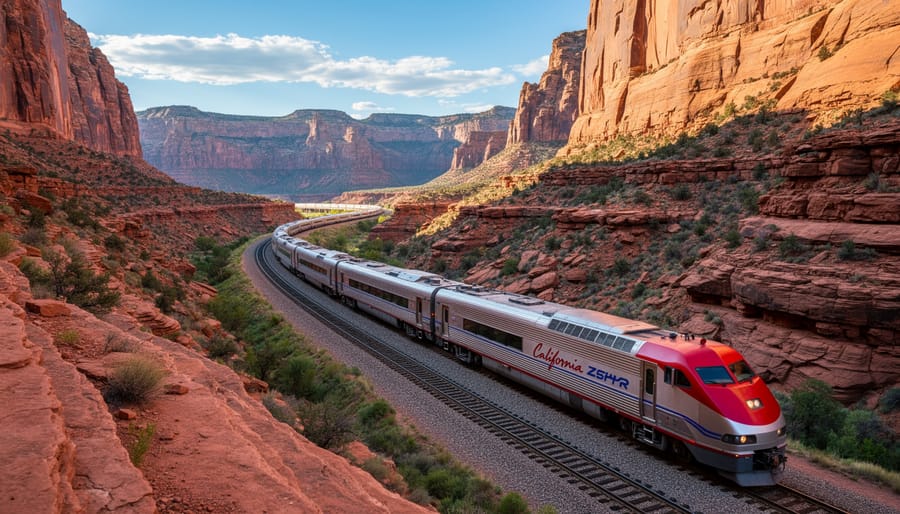
Just west of Glenwood Springs, the California Zephyr trades alpine grandeur for something equally mesmerizing: the raw, geological spectacle of western Colorado’s canyon country. This 90-mile segment to Grand Junction deserves its own ranking because the landscape transforms completely, offering scenery you won’t find anywhere else on the route.
The journey begins with Glenwood Canyon itself, where the train hugs vertical limestone walls rising over 1,000 feet above the Colorado River. Morning light turns the canyon walls amber and gold, while afternoon shadows create dramatic contrasts in the rock layers. You’ll spot whitewater rafters below and bighorn sheep on the cliffs if you’re lucky, keep your camera ready on the north side of the train.
After Glenwood Canyon, watch the ecosystem shift. Aspen and pine give way to pinyon and juniper. The Rockies recede into your rearview as high desert mesas and red rock formations take center stage. Near Rifle, layers of sedimentary rock tell 300 million years of Earth’s story in bands of rust, cream, and ochre.
The approach to Grand Junction showcases the Colorado Plateau’s signature landscape: flat-topped mesas, eroded buttes, and that distinctive red soil that seems to glow at sunset. The Book Cliffs form a stunning northern backdrop, a 200-mile escarpment that looks like nature’s own fortress wall.
While the Denver-Glenwood segment wins for concentrated mountain drama, this western continuation offers geologic diversity and color that mountain forests can’t match. It’s a different kind of beautiful, and absolutely worth experiencing.
3. Southwest Chief: Trinidad to La Junta, Southern Colorado’s Hidden Gem
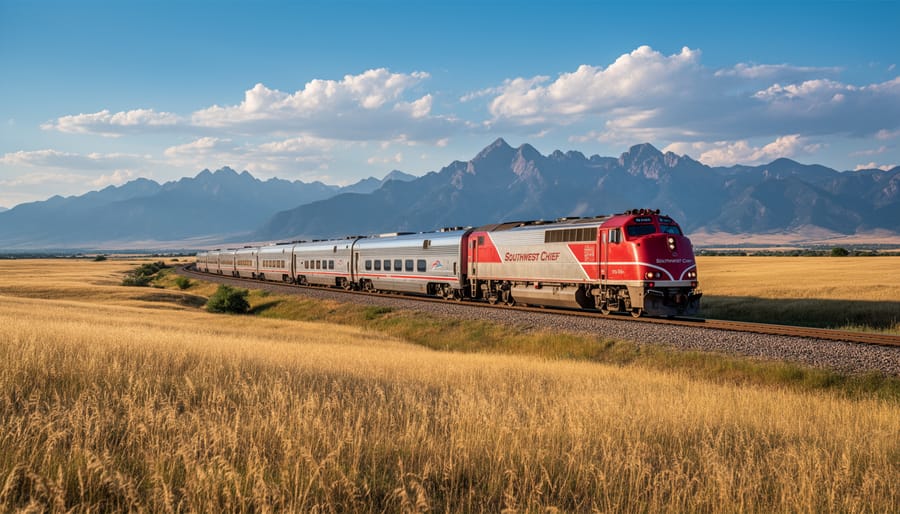
The Southwest Chief’s journey from Trinidad to La Junta reveals a Colorado most visitors never see, and that’s precisely its charm. This 85-mile segment traces the historic Santa Fe Trail through southern Colorado’s highlands, where the state’s geography shifts from rugged mountain terrain to sweeping grasslands in spectacular fashion.
Departing Trinidad at roughly 6,400 feet elevation, the route immediately climbs toward Raton Pass, offering front-row views of the twin Spanish Peaks rising dramatically from the plains. These volcanic remnants, sacred to Indigenous peoples and landmarks for pioneer travelers, dominate the southern horizon with a majesty that rivals better-known Colorado peaks. The contrast is striking: jagged mountains framed by endless prairie rather than surrounded by other ranges.
What sets this route apart is its historical resonance. You’re traveling the same corridor that traders, settlers, and fortune-seekers followed westward. The landscape tells that story through adobe-style architecture in Trinidad, weathered grasslands, and the gradual descent into the Arkansas River valley near La Junta.
Photographers love the changing light here. Morning departures bathe the Spanish Peaks in golden alpenglow, while afternoon runs illuminate the transition zone where ponderosa pine gives way to short-grass prairie. Wildlife sightings, pronghorn antelope, hawks circling thermals, occasional deer, add spontaneous moments of wonder.
For travelers weary of crowded Rocky Mountain hotspots, this segment offers authentic solitude and a reminder that Colorado’s beauty extends far beyond its famous ski towns and national parks. It’s raw, understated, and genuinely different.
4. California Zephyr: Denver to Fort Morgan, Front Range and Eastern Plains
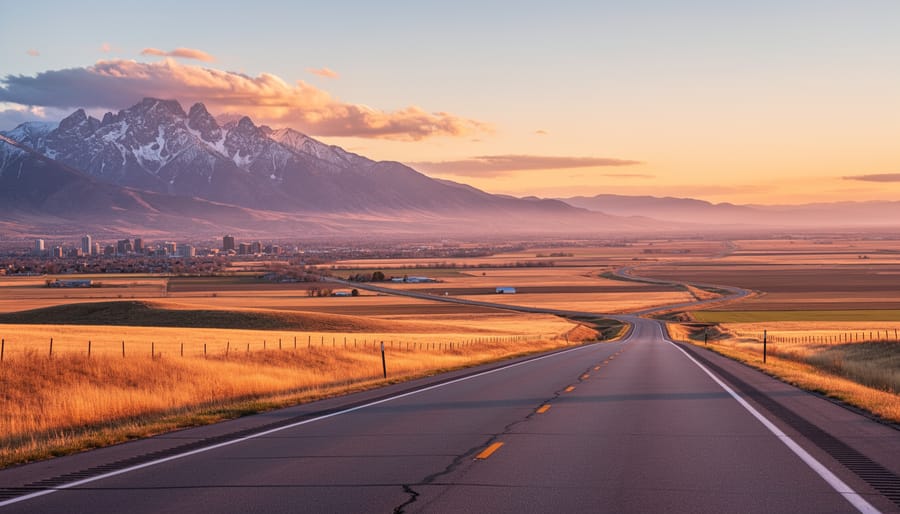
The California Zephyr’s eastward journey from Denver to Fort Morgan offers an entirely different flavor of Colorado beauty, one that unfolds in subtle brushstrokes rather than dramatic peaks. This segment appeals to travelers who appreciate open horizons and the quiet grandeur of the high plains.
As the train departs Denver’s Union Station, you’ll catch sweeping views of the Front Range stretching north and south, with Longs Peak standing sentinel to the northwest. The urban landscape gives way quickly to rolling prairie, where the mountains gradually recede into a blue-tinged backdrop. It’s this transition itself that makes the journey memorable, watching Colorado’s famous peaks shrink to silhouettes while the sky seems to expand infinitely overhead.
The real magic happens during evening departures, when golden hour bathes the eastern plains in amber light. Photographers love this segment for its unobstructed prairie sunsets, where there’s nothing between you and the horizon except swaying grasses and occasional windmills. Local guest contributors often recommend this route for families with young children, since the gentler scenery and flat terrain can be less overwhelming than narrow mountain passes.
While it won’t make your heart race like Gore Canyon, the Denver-Fort Morgan segment provides a contemplative counterpoint to Colorado’s mountain drama. It’s proof that scenic beauty doesn’t always require elevation, sometimes it’s found in space, light, and endless sky.
5. Southwest Chief: La Junta to Kansas Border, Wide Open Spaces
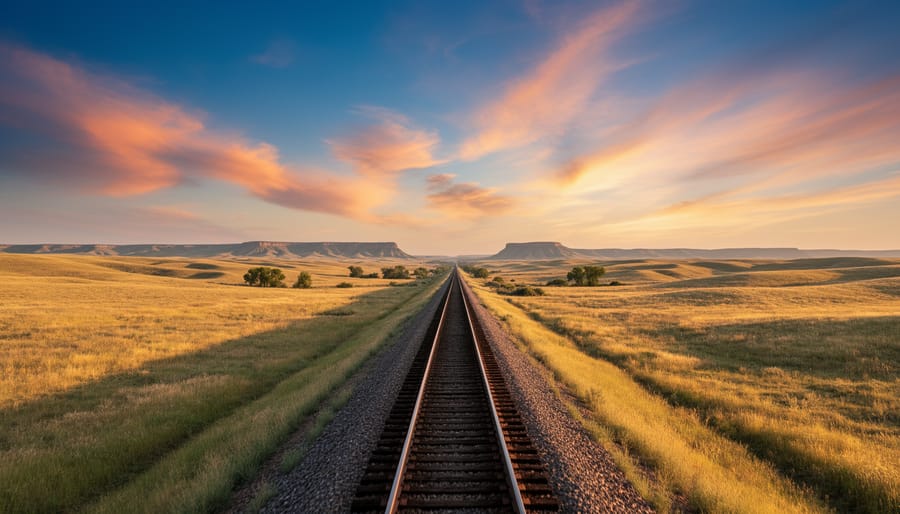
Eastern Colorado gets dismissed too quickly by travelers chasing mountain peaks, but the Southwest Chief’s route from La Junta to the Kansas border reveals a different kind of majesty. Here, the landscape opens into endless horizons where earth meets sky in a seamless arc, and the subtle drama of the high plains unfolds in layers of color and light.
This segment shines during golden hour, that magical window when low sun paints the grasslands amber and casts long shadows across the rolling terrain. Photographers love this route for its unobstructed views and the way storm systems develop across the vast expanse, creating dramatic cloudscapes you can watch for miles. The train cuts through wheat fields, prairie grasses, and scattered ranches where pronghorn antelope sometimes keep pace alongside the tracks.
What makes this route special isn’t spectacle but simplicity. It’s contemplative travel at its finest, offering the mental space that comes from wide-open country. You’ll spot windmills spinning lazily, historic grain elevators marking small towns, and the occasional hawk riding thermals. The absence of dense forests and towering peaks means nothing blocks your view, just pure, sweeping vistas that stretch to the curve of the earth.
For those wanting to plan a longer trip this segment pairs well with the Raton Pass section, giving you both mountain drama and prairie solitude in one journey. Best experienced with your phone tucked away, letting the rhythm of the rails and the endless sky work their quiet magic.
6. Winter Park Ski Train (Amtrak Partnership Route), Seasonal Alpine Access
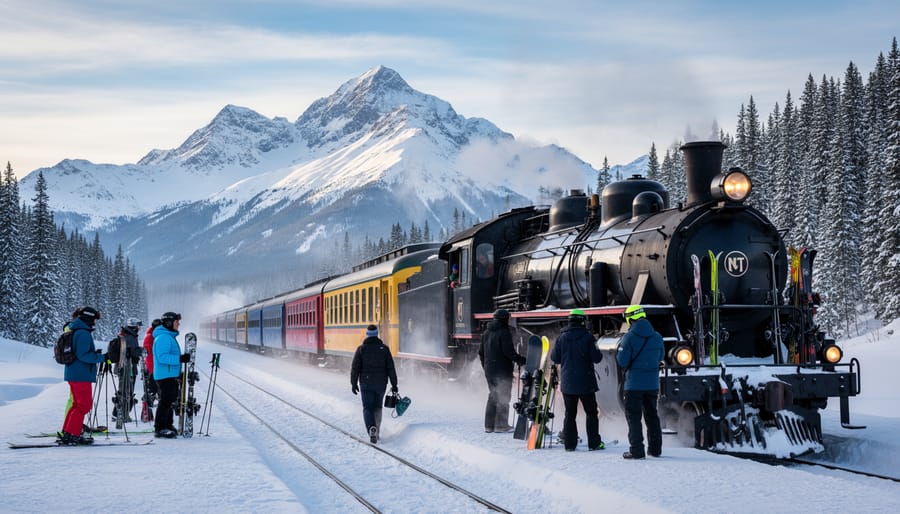
The Winter Park Ski Train operates on weekends from late December through March, delivering skiers and snowboarders from Denver’s Union Station directly to the slopes in roughly two hours. This partnership route uses Amtrak’s rail infrastructure but runs as a dedicated service, not a typical Amtrak train with multiple stops and extended routing.
Scenically, it’s a focused alpine experience rather than a diverse landscape journey. You’ll climb through Clear Creek Canyon, pass through the Moffat Tunnel beneath the Continental Divide, and emerge into the Fraser Valley surrounded by snow-dusted peaks. The views are undeniably stunning, particularly that first glimpse of the Winter Park valley, but the relatively short duration and single-purpose trajectory mean less scenic variety than the multi-hour California Zephyr segments.
Where this route excels is targeted adventure. You board with your skis, avoid I-70 traffic nightmares, and step off steps from the lifts. Families appreciate the stress-free logistics. Solo travelers enjoy the communal energy of excited skiers. The onboard atmosphere feels less like sightseeing and more like the start of an adventure, with passengers swapping beta about powder conditions.
It ranks lower for pure scenic diversity because you’re trading breadth for convenience and seasonal immersion. But if your goal combines spectacular winter landscapes with actual mountain recreation rather than observation alone, this route delivers intensely. For more mountain views across different seasons and terrains, consider Colorado’s year-round scenic train options that prioritize landscape over destination skiing.
How Colorado’s Scenic Train Routes Compare to Amtrak
Amtrak routes deliver scenery as part of a larger journey, connecting cities across Colorado and beyond. They’re your working transportation that happens to pass through stunning landscapes. Colorado’s heritage scenic railroads, by contrast, exist purely for the views.
The Durango & Silverton Narrow Gauge Railroad runs 45 miles through the San Juan Mountains on tracks where scenery is the entire point. You’ll travel at a leisurely pace through roadless wilderness that hasn’t changed since the 1880s. The Royal Gorge Route Railway hugs canyon walls 1,000 feet above the Arkansas River, offering perspectives you can’t get from any highway or Amtrak line. The Pikes Peak Cog Railway climbs to 14,115 feet, reaching alpine tundra that no train in the Amtrak network touches.
What Amtrak gives you is connectivity. You can board in Denver, watch the Rockies unfold through your window, and step off in Glenwood Springs or continue west to California. Heritage routes are round-trips or point-to-point experiences within a single region. They don’t connect you to the broader rail network, and they cost more per mile.
For photographers and families wanting guaranteed window time at slow speeds through wilderness, heritage trains win. For travelers weaving scenic segments into longer journeys or working with tighter budgets, Amtrak’s practicality can’t be beat.
Planning Your Scenic Amtrak Journey Through Colorado
Book directly through Amtrak’s website for the best flexibility and seat selection, reserve window seats on the north side for the California Zephyr’s Denver-Glenwood segment to catch the best canyon views. Spring through early fall offers the most diverse scenery, though winter transforms the landscape into a snow-draped wonderland that’s equally stunning. If you’re considering exploring beyond Amtrak’s offerings, Colorado’s scenic train routes include heritage railways that complement the long-distance Amtrak experience.
- Bring binoculars for wildlife spotting and distant peak identification
- Pack snacks and refillable water bottles (café car prices add up)
- Charge your camera and phone fully, outlets can be scarce
- Layer clothing since onboard temperatures fluctuate
- Download offline maps and entertainment for connectivity dead zones
Amtrak’s accessibility features include wheelchair spaces, accessible restrooms, and assistance at staffed stations, call ahead to arrange specific accommodations. Coach seats recline comfortably with generous legroom, but sleeper cars provide beds and meals for those planning multi-day train rides beyond Colorado’s borders. Our community recommends arriving at Denver’s Union Station early to explore its historic architecture and grab coffee before boarding. The observation car becomes the social heart of the journey, where travelers swap stories and point out landmarks together.
Common Questions About Scenic Amtrak Travel in Colorado
Which side of the train should I sit on for the best views?
On the California Zephyr heading west from Denver, sit on the north side (right when facing forward) for the best mountain and canyon views through Glenwood Canyon. The Southwest Chief offers equally good views from both sides through southern Colorado’s varied terrain.
Can you see Pikes Peak from Amtrak?
You’ll catch glimpses of Pikes Peak from the California Zephyr as it departs Denver, but only briefly. For sustained Pikes Peak views, you’ll want to explore Colorado’s dedicated mountain railways instead.
Are sleeper cars worth it for scenic routes?
Sleeper cars make sense for overnight segments or if you’re combining scenic viewing with best multi-day routes beyond Colorado. For daytime-only scenic segments like Denver to Glenwood Springs, coach seats with big windows work perfectly well and cost significantly less.
What’s the best time of year for scenic Amtrak travel?
Late September through mid-October delivers spectacular fall colors in the mountain corridors, while June brings rushing rivers and lingering snow caps. Winter offers dramatic contrast and fewer crowds, though shorter daylight limits viewing time on longer routes.
How do I photograph landscapes from a moving train?
Use a fast shutter speed (1/500th or faster) to freeze motion, shoot through clean windows rather than open vestibules for stability, and embrace the foreground blur as part of the story. The best shots often happen when you’re just enjoying the view rather than constant shooting.
All these routes run year-round, though winter weather occasionally causes delays in mountain passes. The trains keep rolling through snow and sun alike, which means you can plan your scenic journey for whenever your schedule allows rather than waiting for a narrow seasonal window.
The California Zephyr’s Denver to Glenwood Springs segment stands unrivaled as Colorado’s most breathtaking rail journey, but each route we’ve explored reveals a different facet of the state’s remarkable landscapes. From alpine grandeur to high desert drama, these routes weave together the complete Colorado story.
Your perfect journey might combine multiple segments or focus on the crown jewel itself. Either way, you’re in for unforgettable vistas that remind us why train travel remains one of adventure’s purest pleasures.
Ready to roll? We’d love to hear which route captured your heart or see photos from your scenic rail adventures. Share your experiences with the Nomadic Adventures community and inspire fellow travelers to discover Colorado from the rails.