
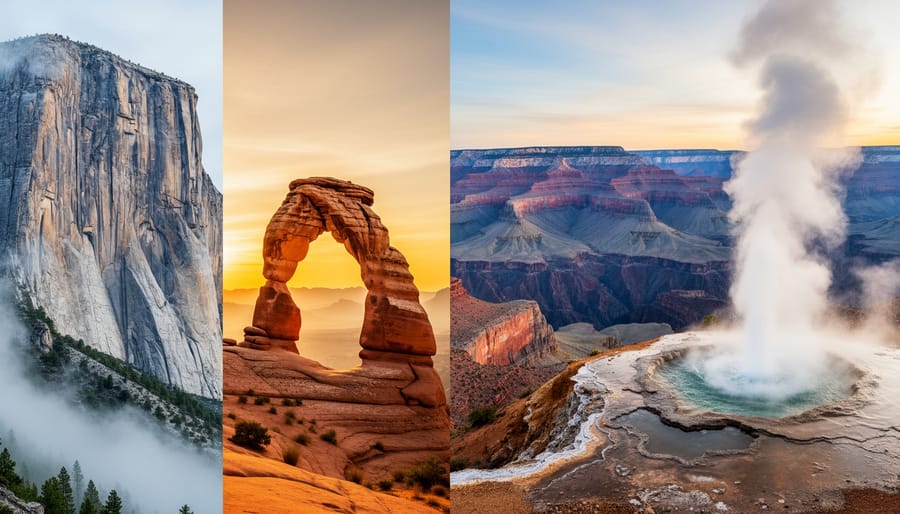
America’s national parks protect eight landmarks so visually stunning they’ve become shorthand for the entire park system: Yosemite’s Half Dome and El Capitan, Arches’ Delicate Arch, the Grand Canyon’s South Rim, Yellowstone’s Old Faithful, Mount Rainier, Zion’s Angels Landing, and Mesa Verde’s Cliff Palace. These are the shots every photographer wants, the views that appear on millions of social media feeds, and the bucket-list destinations that define what a national park should look like.
For Colorado travelers, most of these icons sit within a day’s drive, making them perfect additions to road trips from Colorado. Arches and Mesa Verde are practically neighbors. Yellowstone, the Grand Canyon, and Zion require longer hauls but reward you with landscapes you won’t find anywhere else. Getting there means crossing mountain passes and high-desert highways, so brush up on navigating dangerous Colorado roads before you load the car.
The National Park Service actively encourages photography across all 63 parks, hosting the annual Share the Experience photo contest and maintaining searchable galleries of visitor-submitted images. But the most famous viewpoints come with crowds, especially during golden hour. We’ve included alternative angles and lesser-known trails for each landmark so you can capture these icons without fighting for tripod space.
How We Chose These Iconic Landmarks
Choosing which landmarks truly deserve “iconic” status required more than just picking the most famous spots, we wanted locations that instantly signal “national park” in the mind of photographers and visitors alike. Our selection drew on several objective measures to ensure these eight landmarks represent the most recognizable features in the park system.
We evaluated each potential landmark against these core criteria:
- Instant recognizability, features that appear frequently in park marketing, postcards, and visitor photography
- Proven photographic appeal demonstrated through submissions to Share the Experience, the official photo contest of America’s national parks
- Cultural significance as defining symbols of their respective parks
- Accessibility for photographers, balancing bucket-list locations with realistic shooting opportunities
- Presence in the NPS multimedia archives, indicating sustained visitor interest across decades
The final eight represent landmarks you’d recognize even without a caption, Half Dome’s distinctive granite profile, Delicate Arch framing the Utah desert, Old Faithful’s predictable eruptions. We prioritized locations where photographers can actually capture meaningful images rather than simply crowded overlooks, though we acknowledge that iconic status often comes with crowds. The balance struck here gives you both the famous viewpoints that define each park and practical guidance for making the shot worth the journey.
1. Half Dome, Yosemite National Park
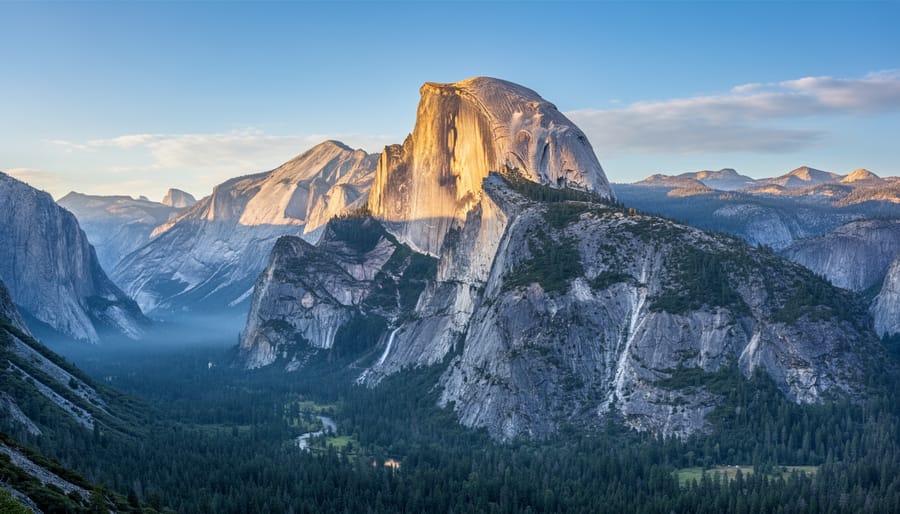
Half Dome’s distinctive shape, a granite dome sheared vertically as if sliced by a cosmic blade, makes it the most recognizable landmark in Yosemite and arguably the most famous icon across the entire national park system. Rising nearly 5,000 feet above Yosemite Valley’s floor, this massive formation appears in more visitor photographs than perhaps any other natural feature in America’s parks.
For photographers, Half Dome delivers drama from every angle. Glacier Point, perched 3,200 feet above the valley, offers the classic telephoto opportunity where you can capture the dome’s full vertical profile against Yosemite’s backcountry peaks. The perspective compresses the landscape, emphasizing Half Dome’s commanding presence.
Down on the valley floor, the composition changes entirely. Shoot from the Ahwahnee Meadow or Mirror Lake in spring, and you’ll catch Half Dome reflected in still water with wildflowers framing the foreground. The low angle transforms the landmark from a distant monument into an approachable giant, its curved cap glowing amber during golden hour.
The best light hits Half Dome’s northwest face in late afternoon when side-lighting reveals every crack and texture in the granite. Winter storms add another dimension, fresh snow coating the summit while mist swirls through the valley creates an ethereal, ever-changing scene.
What makes Half Dome endlessly photogenic isn’t just its shape but its versatility. Whether you’re shooting with a wide-angle lens from the valley or a telephoto from distant viewpoints, this landmark transforms simple snapshots into portfolio-worthy images.
2. Delicate Arch, Arches National Park
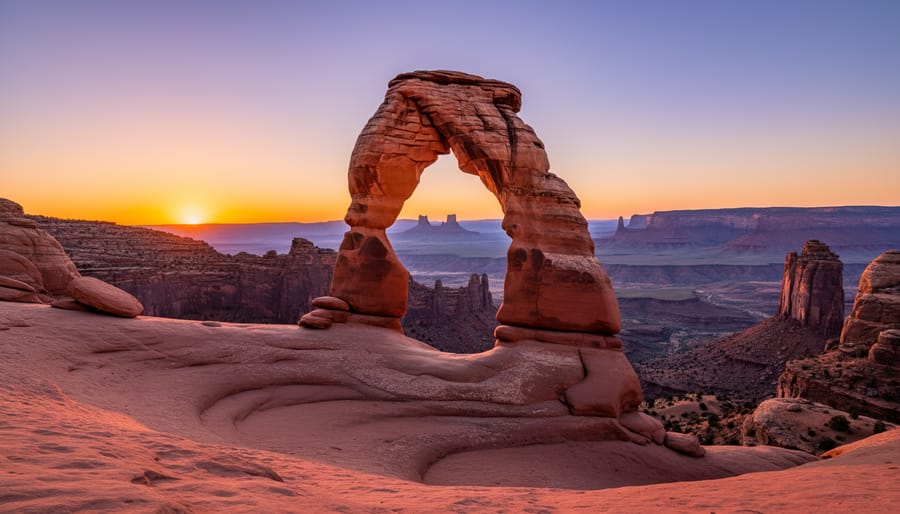
Utah’s official state symbol appears on license plates across the Southwest for good reason. Delicate Arch stands 64 feet tall atop a sandstone bowl, creating what might be the most photographed natural frame in America’s park system. The arch’s position makes it particularly stunning at sunset, when the red rock glows orange against the La Sal Mountains backdrop.
The 3-mile roundtrip trail to reach Delicate Arch isn’t technically difficult, but it gains 480 feet of elevation across slickrock with minimal shade. Start early in summer or late afternoon for sunset shoots, midday heat on exposed rock can be brutal. The final approach follows a narrow ledge before opening onto the bowl where the arch commands its ridge.
Photographers crowd the rim for golden hour, and for good cause. As the sun drops toward the western horizon, the arch transitions through shades of amber, rust, and deep crimson. The east-facing position means you’re shooting into ideal light, with the arch silhouetted first, then catching direct glow just before sunset.
Lower Delicate Arch Viewpoint offers a distant perspective without the hike, but you lose the scale and drama. Upper Viewpoint requires a quarter-mile walk and puts you across the canyon rather than at the arch’s base. Neither compares to standing in that sandstone amphitheater as sunset light paints the formation.
Bring more water than you think you need. The trail’s deceptively demanding, and there’s no bailout once you’re halfway up.
3. El Capitan, Yosemite National Park
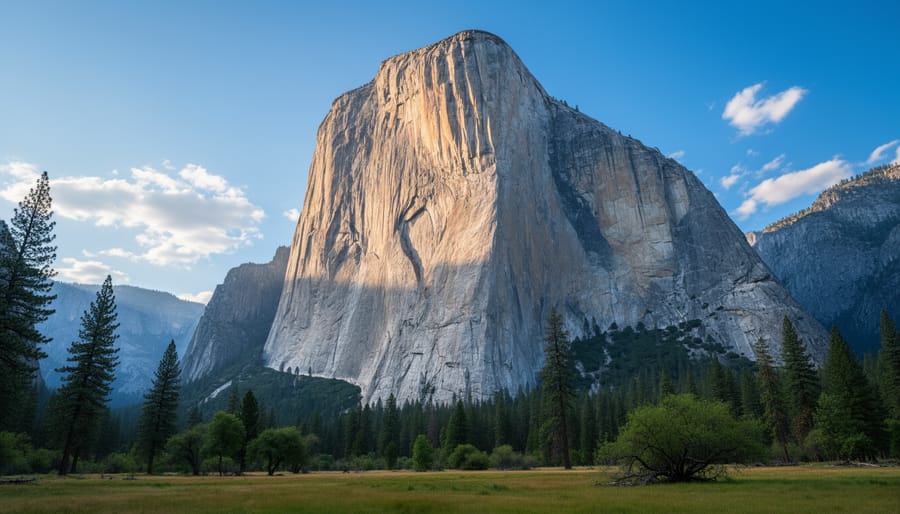
El Capitan rises 3,000 feet from Yosemite Valley’s floor, a sheer granite wall that commands attention the moment you enter the park from the west. Unlike Half Dome’s distant majesty, El Cap dominates your field of vision, you can’t miss it, and photographers spend entire visits trying to capture its overwhelming vertical presence.
The challenge with El Capitan is scale. Your wide-angle lens will struggle to convey just how massive this monolith truly is. Including foreground elements helps: meadow grasses in spring, the Merced River’s reflections, or even the tiny specks of climbers on the rock face (binoculars help spot them). Shooting from El Capitan Meadow puts you at the classic angle, though you’ll share the space with dozens of other photographers during peak season.
Lighting transforms El Cap throughout the day. Morning sun illuminates the southeast face with warm gold, while late afternoon and sunset paint the entire wall in graduated tones from amber to deep crimson. Winter offers something special: when temperatures drop and moisture clings to the granite, El Capitan can appear almost black against snow-covered valley floors, creating stark monochrome compositions.
For a different perspective, hike partway up the Valley View Trail on the opposite side. You’ll gain elevation and a less-crowded angle that shows El Cap’s relationship to the surrounding valley walls. Don’t ignore stormy conditions either, clouds partially obscuring the summit add drama that sunny-day shots often lack.
4. Yosemite Falls, Yosemite National Park
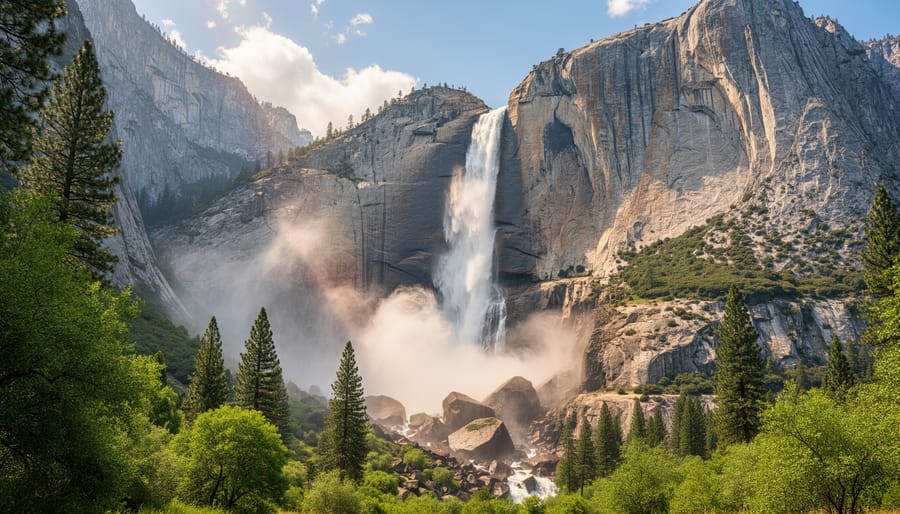
Yosemite Falls drops 2,425 feet in three distinct sections, making it the tallest waterfall in North America and a landmark that defines the park’s vertical scale. When the snowmelt peaks in late spring, the thundering cascade sends spray visible across the entire valley floor, a photographer’s opportunity that disappears by late summer when the falls often run completely dry.
The base trail provides the classic shot from Yosemite Village, a half-mile walk that puts you directly in front of the lower cascade with rainbows forming in the mist on sunny afternoons. This spot gets crowded for good reason: you can capture the full height of the falls framed by towering pines without technical climbing skills. For a different perspective, the seven-mile Upper Yosemite Falls trail climbs to the brink where you can photograph the water’s edge before it launches into space, though that requires stamina and a full day.
Swinging Bridge offers another angle that photographers overlook, it frames the falls between meadow grasses with the Merced River in the foreground, particularly striking at sunrise when the eastern light hits the white water. Valley View and Tunnel View also include Yosemite Falls in their compositions, though from these spots it becomes one element in the broader valley panorama rather than the star.
Time your visit for April through June when the falls roar at full volume. By August, you’ll photograph dry granite where a waterfall should be.
5. Grand Canyon South Rim Viewpoints
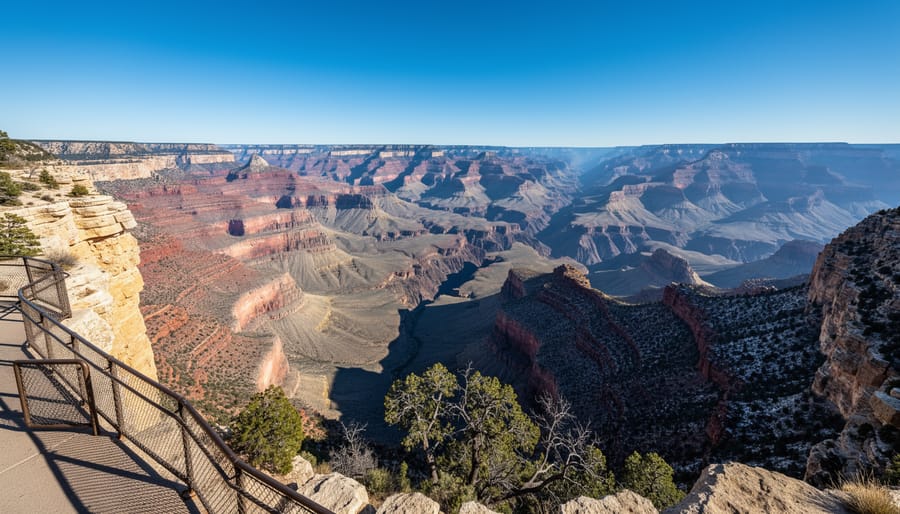
The Grand Canyon’s South Rim delivers what might be the single most recognizable landscape in American photography. That layered panorama of red rock striations stretching toward the horizon appears instantly familiar even to first-time visitors, it’s been stamped onto postcards, calendars, and screensavers for generations.
Mather Point greets most visitors arriving at the main entrance and offers an immediate, sweeping vista that captures the canyon’s immense scale. The overlook sits at a natural bend in the rim, providing sight lines both east and west along the gorge. Morning light here brings out the warm ochre tones in the Coconino sandstone layers.
Yavapai Point, just a mile east, gives photographers cleaner foreground compositions with fewer railings in frame. The geology observation station there also helps you understand what you’re shooting, those distinct bands of Kaibab limestone, Toroweap formation, and Vishnu schist that make the canyon so photogenic.
For sunset, Hopi Point extends farther into the canyon than any other South Rim viewpoint, letting you capture the Colorado River as it catches the last golden light. The westward orientation means you can shoot directly into the alpenglow as it sets the canyon walls ablaze.
What makes these viewpoints so iconic is their accessibility combined with that unmistakable depth. The rim-to-river drop of over 4,000 feet creates atmospheric perspective that shifts from sharp foreground detail to hazy blue ridges receding into Arizona’s distance, a visual signature no other American landmark quite matches.
6. Old Faithful, Yellowstone National Park
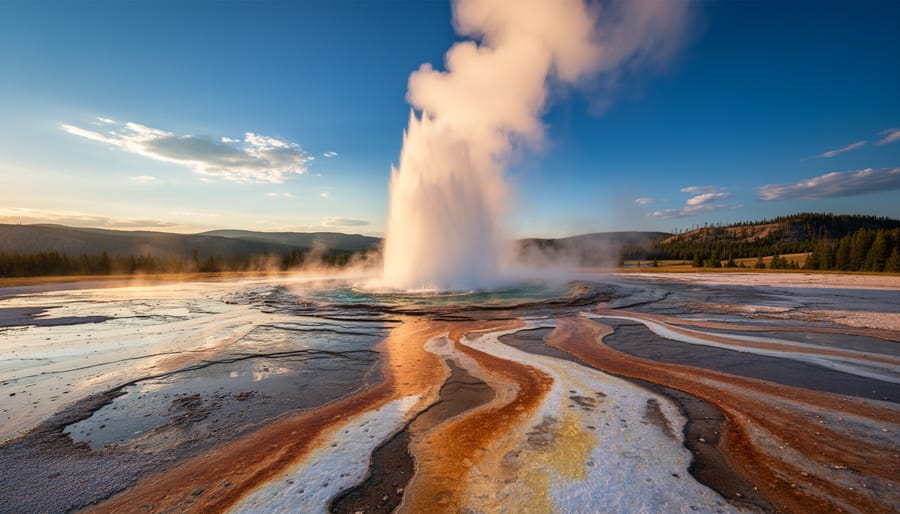
Old Faithful lives up to its name, erupting roughly every 90 minutes with remarkable consistency, making it easier to plan your shoot than chasing wildlife or hoping for perfect light. This predictability, combined with its dramatic 130-foot plumes, has made Yellowstone’s signature geyser the most photographed thermal feature in the world.
Check the predicted eruption times posted at the visitor center or on the NPS app, then arrive at least 20 minutes early to claim a spot along the boardwalk. The best light happens during golden hour, when side-lighting illuminates the steam column against a darker background. Midday eruptions look washed out, though winter shoots offer a striking contrast as steam billows against snow and frozen pines.
Don’t pack up immediately after the main event. The surrounding Upper Geyser Basin contains the world’s highest concentration of geothermal features, including Castle Geyser and Morning Glory Pool. These neighboring attractions often appear deserted while everyone clusters around Old Faithful’s platform, giving you cleaner shots without tourists in every frame.
Bring a fast shutter speed (1/500 or higher) to freeze the water droplets mid-eruption, or slow it down to 1/60 for a softer, more ethereal steam effect. Either way, you’ll capture why this single landmark has symbolized Yellowstone since the park’s founding in 1872.
7. Mount Rushmore National Memorial
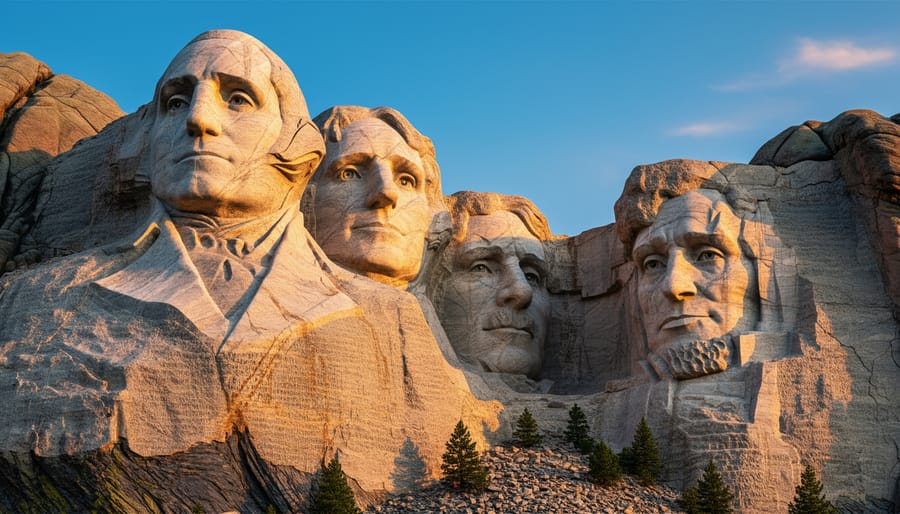
The carved faces of Washington, Jefferson, Theodore Roosevelt, and Lincoln gazing across the Black Hills make Mount Rushmore one of America’s most instantly recognizable monuments, though it’s technically a National Memorial rather than a National Park. For photographers, the challenge isn’t finding the landmark but capturing it in a way that does justice to the 60-foot presidential visages carved into the granite mountainside.
The Grand View Terrace offers the classic straight-on perspective that appears in countless photos, but serious photographers arrive early or stay late. Morning light from the east illuminates the faces directly, bringing out the sculptural detail in Washington’s profile and the shadows that define Lincoln’s features. Late afternoon creates dramatic side lighting that emphasizes the three-dimensional depth of the carving.
Winter transforms Mount Rushmore into a different subject entirely. Snow dusting the presidents’ heads and the surrounding ponderosa pines creates a stark black-and-white contrast that’s particularly striking in photography. Summer brings perfect weather but also maximum crowds, plan to shoot from the Presidential Trail below the monument for less-congested angles that include the talus pile of granite rubble at the base.
The Avenue of Flags leading to the viewing terrace adds patriotic context to wider compositions, while telephoto lenses let you isolate individual presidents against the South Dakota sky.
8. Mesa Arch, Canyonlands National Park
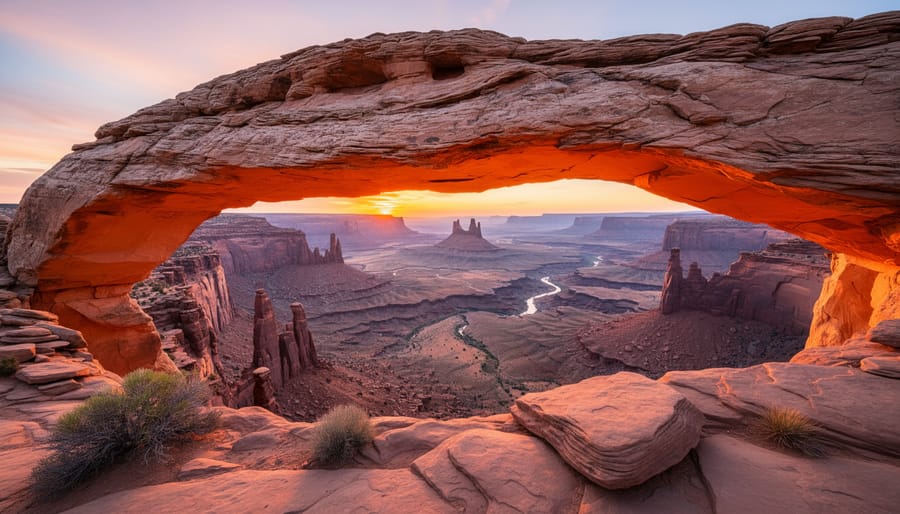
Mesa Arch sits on the edge of a sandstone cliff in Canyonlands’ Island in the Sky district, and at sunrise it transforms into the Southwest’s most dramatic natural picture frame. The arch itself spans about 45 feet, but what makes it legendary among photographers is the way it glows fiery orange when the rising sun illuminates its underside, a phenomenon that lasts only a few minutes each morning.
This arch has become one of the most photographed formations in Utah’s canyon country because it offers something genuinely rare: a foreground element that perfectly frames the distant La Sal Mountains and the vast canyon system beyond. The composition practically creates itself, which explains why you’ll find dozens of tripods lined up along the cliff edge before dawn during peak season.
The hike is mercifully short, only a half-mile round trip from the parking area, making it accessible even with heavy camera gear. Arrive at least 45 minutes before sunrise to secure a good spot and set up your equipment in the dark. Fair warning: you’ll be shoulder-to-shoulder with other photographers during spring and fall, so scout some of the lesser-known Utah arch alternatives if you prefer solitude with your landscapes.
Beyond the Crowds: Alternative Viewpoints Worth Exploring
The most famous viewpoints draw thick crowds by midday, especially in summer. If you’re craving solitude with your camera, venture beyond the classic postcard shots.
In Yosemite, skip the valley floor chaos and hike to North Dome for a head-on perspective of Half Dome without the throngs at Glacier Point. Indian Ridge offers sweeping granite vistas with a fraction of the traffic, while the Perimeter trails loop you through quieter forest zones with sudden cliff-edge reveals. These routes reward you with fresh angles the Instagram masses never see.
At Arches, while everyone queues for Delicate Arch at sunset, head to Double Arch or the Windows section early morning when the light paints the sandstone orange and you’ll practically have the formations to yourself. Canyonlands’ Grand View Point offers mesa-top panoramas that rival Mesa Arch’s fame but see far fewer tripods. In Yellowstone, photographers who venture to Norris Geyser Basin or the Lamar Valley find thermal features and wildlife backdrops every bit as dramatic as Old Faithful’s crowd scene.
These alternatives let you capture the essence of multi-day national parks without battling elbows for tripod space. Smart park photography planning means scouting lesser-known trails that deliver iconic views on your own terms.
Making the Most of Your National Park Photography Trip
Before you hit the road to photograph these legendary landmarks, spend time on the National Park Service website, you can explore the parks through multimedia resources including searchable photo galleries, videos, webcams, and audio files that help you scout locations and visualize lighting conditions before you arrive. This digital reconnaissance lets you plan shooting angles and identify weather patterns that’ll make or break your shots.
Some of the most iconic viewpoints require permits, particularly for sunrise shoots at places like Mesa Arch or photography in wilderness areas. Check each park’s website for current requirements and reservation systems well in advance, popular spots book up months ahead during peak season.
If you’re road-tripping from Colorado to distant parks like Yosemite or Yellowstone, factor in elevation changes and weather conditions, especially if you’re crossing mountain passes with camera gear. Dangerous roads demand extra caution when you’re focused on reaching golden hour at your destination. Pack your equipment securely and build buffer time into your schedule so you’re not rushing through technical terrain.
Once you’ve captured these iconic landmarks, consider entering your best work in Share the Experience, the official photo contest of America’s national parks. It’s a chance to showcase your vision of these legendary locations alongside photographers from across the country.
These eight landmarks stand as America’s most photographed national park features, each offering that instantly recognizable “I’ve arrived” moment photographers crave. From Yosemite’s granite giants to Utah’s delicate arches, they represent the visual touchstones that define our national park system. But the real magic happens when you venture beyond the classic viewpoints, those alternative trails and hidden vantage points often deliver equally stunning compositions without the elbow-to-elbow crowds.
Which national park has the most iconic landmarks?
Yosemite National Park claims the highest concentration of world-famous landmarks, including Half Dome, El Capitan, Yosemite Falls, Glacier Point, and multiple giant sequoia groves. No other park matches its density of instantly recognizable features.
What’s the best time to photograph these landmarks?
Golden hour, the hour after sunrise and before sunset, delivers the most dramatic lighting at most landmarks. Mesa Arch shines specifically at sunrise, while Delicate Arch peaks at sunset.
Do I need permits to photograph at national parks?
Casual photography requires no special permits, just park entrance fees. Commercial shoots or certain backcountry locations may require advance permits from individual parks.
How can I avoid crowds at popular photo spots?
Arrive before dawn at sunrise locations or explore alternative viewpoints like North Dome or Indian Ridge in Yosemite. Weekdays outside summer and major holidays also see lighter traffic.
If you’re road-tripping from Colorado to reach these distant parks, plan your routes carefully and stay alert on mountain passes, especially when chasing that perfect dawn light after a long drive. The landmarks will still be there tomorrow if conditions aren’t right today.