
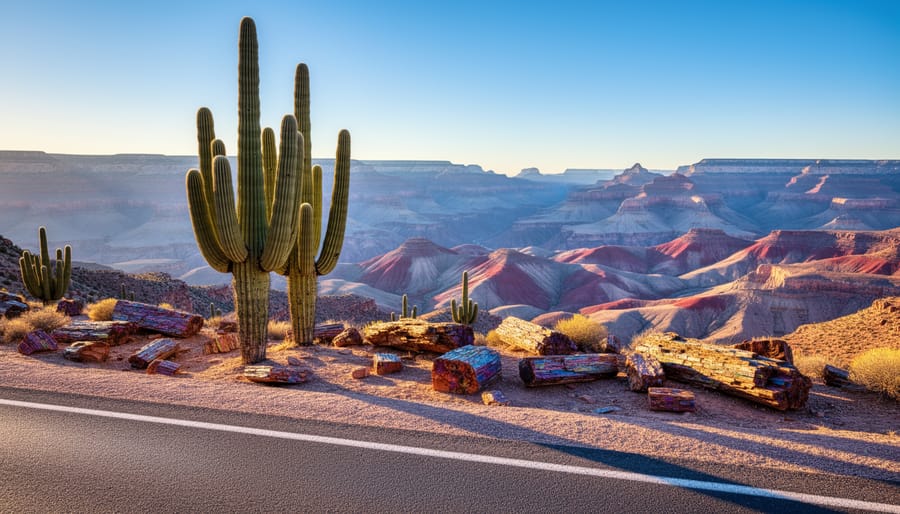
Arizona is home to three stunning national parks: Grand Canyon, Saguaro, and Petrified Forest. Each offers a completely different slice of the Southwest, from the world’s most famous mile-deep gorge to towering desert cacti and ancient fossilized forests that predate the dinosaurs.
If you’re driving from Colorado to explore the Southwest, you’re in luck. All three parks sit within reasonable road trip distance and deliver experiences you simply can’t find anywhere else. The Grand Canyon showcases nearly two billion years of Earth’s geological history carved into dramatic red rock layers. Saguaro protects thousands of iconic giant cacti across two distinct desert districts near Tucson. Petrified Forest preserves a 225-million-year-old landscape where fallen trees turned to rainbow-colored stone.
Most travelers can visit each park as a day trip or weekend getaway, though the Grand Canyon warrants more time if you plan to hike below the rim. Entry fees apply at all three, but your America the Beautiful pass covers entrance for everyone in your vehicle, making it a smart investment if you’re hitting multiple parks on the same trip.
This guide breaks down what makes each park special, the best times to visit, and practical tips from locals who know these protected lands well. Whether you’re chasing sunrise over the canyon, photographing saguaros at golden hour, or hiking through ancient badlands, Arizona’s national parks deliver adventure that rivals anything you’ll find back home in Colorado.
Why Arizona’s National Parks Are Worth the Journey
If you’re used to Colorado’s alpine meadows and pine-covered peaks, Arizona’s national parks will feel like stepping onto another planet. The state’s three parks, Grand Canyon, Saguaro, and Petrified Forest, showcase a completely different side of the American West, one where towering saguaro cacti replace evergreens, ancient stone forests tell stories from millions of years ago, and geological layers reveal Earth’s history in ways the Rockies simply can’t match.
These aren’t just different landscapes, they’re entirely different ecosystems worth experiencing. Where Colorado rewards you with high-altitude adventures and mountain panoramas, Arizona delivers heat, color, and geology on a scale that photographs can’t capture. The Grand Canyon’s mile-deep chasm still stops visitors mid-sentence. Saguaro’s forests of 40-foot cacti create a classic Southwestern scene that feels iconic the moment you see it. Petrified Forest’s rainbow-hued badlands and stone logs spark curiosity about what this place looked like 200 million years ago.
For Colorado travelers who already love the outdoors, these parks scratch a different itch, they challenge your assumptions about what a landscape can look like and remind you why exploring beyond your home state matters.
Arizona’s Three National Parks: What to Expect
1. Grand Canyon National Park
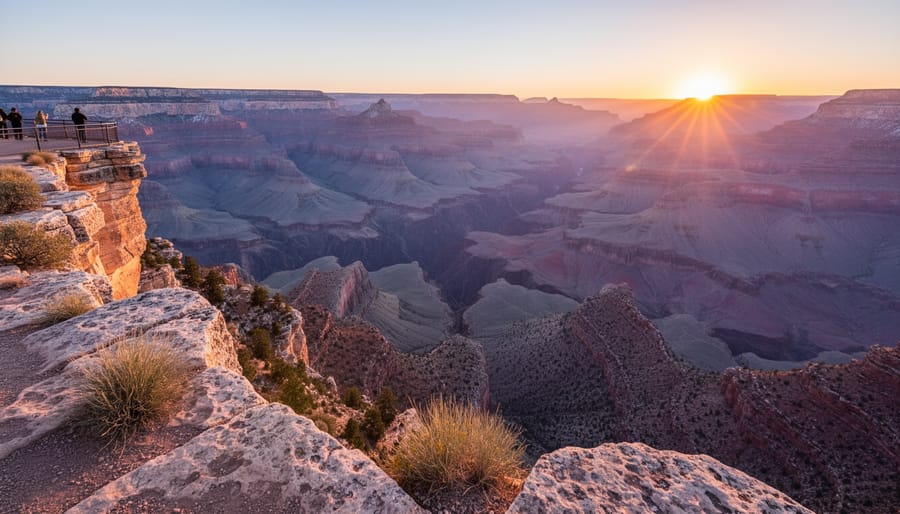
The Grand Canyon stands as Arizona’s most famous natural landmark, a mile-deep chasm carved by the Colorado River over millions of years. The sheer scale overwhelms first-time visitors, 277 miles long, up to 18 miles wide, and dropping more than 6,000 feet from rim to river. For Colorado travelers accustomed to mountain scenery, the Grand Canyon offers a completely different kind of vertigo: looking down into layer after layer of ancient rock rather than up at peaks.
Most visitors explore the South Rim, which stays open year-round and offers the most accessible viewpoints and services. Mather Point and Yavapai Observation Station give you instant gratification, dramatic canyon vistas right from the parking area. The Rim Trail connects these viewpoints along an easy, mostly paved path where families can walk at their own pace. Sunrise and sunset transform the canyon’s colors from oranges and reds to deep purples, and you’ll find photographers lined up at popular spots during these golden hours.
Adventure seekers gravitate toward the rim-to-rim trails. The Bright Angel Trail drops 4,380 feet over 9.5 miles to the Colorado River, passing through distinct climate zones and geological eras. South Kaibab Trail offers more exposed ridge walking with bigger views but no water sources. Don’t underestimate these hikes, what goes down must come up, and ascending back to the rim requires serious fitness and preparation. Many Colorado hikers, used to thin air at altitude, find the desert heat and direct sun more challenging than expected.
The North Rim sits 1,000 feet higher and gets only 10 percent of the park’s visitors. It opens mid-May through mid-October, offering a quieter, forested canyon experience with trails like North Kaibab leading into the inner canyon. The five-hour drive between rims means most people choose one or the other, not both, unless they’re planning a multi-day backcountry trek.
2. Saguaro National Park
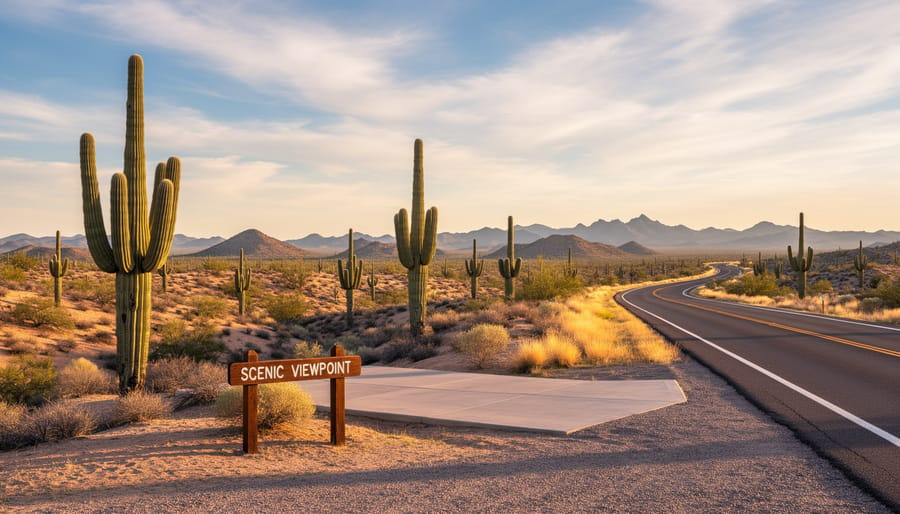
Saguaro National Park flanks both sides of Tucson, split into two districts that showcase the Sonoran Desert’s signature giants. The Tucson Mountain District (west of the city) and the Rincon Mountain District (east) each offer distinct desert experiences, though both are dominated by the iconic saguaro cactus forests that define Arizona’s desert imagery.
The Tucson Mountain District is smaller and easier to access, making it a solid first stop. The six-mile Bajada Loop Drive winds through dense stands of mature saguaros, some reaching forty feet tall and over a century old, against a backdrop of rugged desert peaks. Pull-outs along the drive offer quick photo opportunities, especially during golden hour when the slanting light catches the ribbed columns of the cacti. Short trails like the Desert Discovery Trail and Valley View Overlook Trail give you a closer look without serious mileage.
The Rincon Mountain District sprawls larger and climbs higher into the mountains. Cactus Forest Drive’s eight-mile paved loop takes you through some of the densest saguaro stands in the park, with multiple trailheads branching off into longer backcountry routes. The Tanque Verde Ridge Trail and Mica Mountain trail system lead into cooler, forested elevations if you’re up for a full day hike, though most visitors stick to the valley floor trails like Freeman Homestead and Garwood Dam, where saguaros stand thick and you can spot desert wildlife without the elevation gain.
Sunset photography here rivals anything you’ll find in Arizona. Position yourself along either loop drive an hour before sunset, when the saguaros silhouette against layers of pink and orange sky. Spring blooms (late April through May) add white flowers atop the cacti, though timing varies with weather.
Both districts charge the standard entrance fee, or you can use your America the Beautiful pass. Plan at least half a day per district, more if you’re hiking beyond the scenic drives. Summer heat makes early morning the only reasonable hiking window; winter and spring offer all-day comfort. Saguaro National Park doesn’t draw Grand Canyon-level crowds, giving you space to explore the Sonoran Desert at your own pace.
3. Petrified Forest National Park
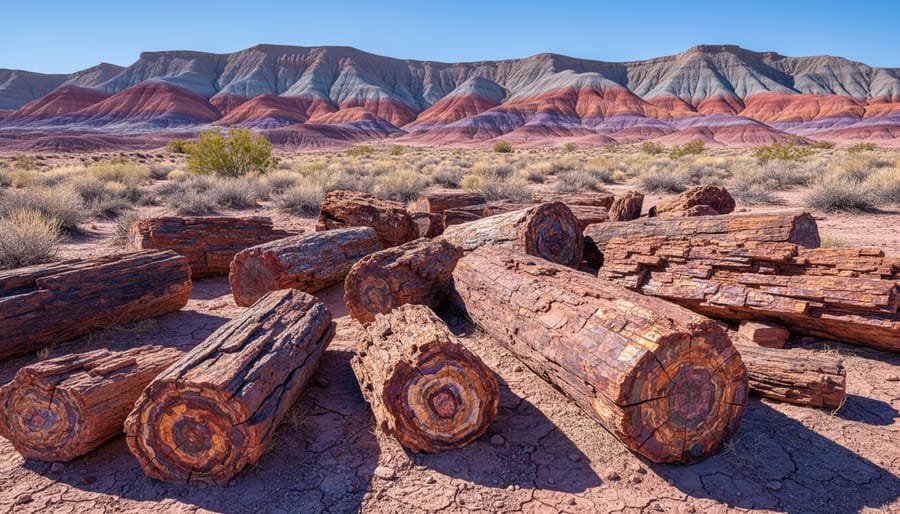
Petrified Forest sits in northeastern Arizona’s high desert, a stark contrast to the deep canyons and towering cacti of the state’s other national parks. This is a landscape of ancient history made visible, you’re walking through a chapter of Earth’s story written 225 million years ago. The park’s namesake petrified wood looks like it should be a forest frozen in time, but these aren’t stone replicas. They’re actual trees transformed into colorful quartz crystals, their rings and bark textures still visible in shades of red, purple, and yellow.
The Painted Desert section of the park delivers exactly what its name promises. Badlands striped in layers of pink, gray, and rust stretch toward distant horizons, particularly striking at sunrise and sunset when the low light intensifies the colors. Drive the 28-mile scenic road through the park and you’ll hit overlooks like Blue Mesa, where you can hike down into the bentonite hills, and Newspaper Rock, covered in ancient petroglyphs left by Ancestral Puebloans.
Route 66 runs right through the park, literally. You’ll cross the old highway’s original alignment and see a 1932 Studebaker abandoned beside the pavement, a reminder of the Mother Road’s heyday. It adds an American nostalgia layer to your visit that’s uniquely Southwestern.
For paleontology enthusiasts, this place is exceptional. Beyond the famous logs, you’ll find fossils of early dinosaurs like Coelophysis displayed at the Rainbow Forest Museum. The park occasionally opens its paleontology lab for visitors to watch researchers at work.
The high-desert environment means elevation around 5,600 feet with temperature swings, hot summer days, chilly nights year-round, and occasional snow in winter. The terrain is exposed with minimal shade, so bring more water than you think you’ll need. Most trails are short (under two miles), making this an accessible park for families, though the lack of dramatic elevation changes means you’re experiencing geology more than physical challenge.
Practical Information for Visiting Arizona’s National Parks
Before you plan a road trip from Colorado to Arizona’s national parks, understanding the practical details makes the experience smoother. Each park operates independently with its own entrance station, but the logistics follow similar patterns that work well for multi-park adventures.
| Park | Entrance Fee | Typical Visit Duration | Best Seasons |
|---|---|---|---|
| Grand Canyon | $35 per vehicle (7 days) | 1-3 days | Spring & Fall (peak); Winter (fewer crowds) |
| Saguaro | $25 per vehicle (7 days) | Half to full day | Fall through Spring; avoid summer heat |
| Petrified Forest | $25 per vehicle (7 days) | Half to full day | Spring & Fall; manageable year-round |
The Entrance Passes and America the Beautiful annual pass ($80) covers entrance fees at all three parks and includes everyone in your vehicle, making it worthwhile if you’re visiting at least two parks during your trip or exploring national parks regularly. This pass works across federal recreation sites nationwide.
From Denver, you’re looking at roughly 600 miles to Grand Canyon’s South Rim (9-10 hours), 850 miles to Saguaro near Tucson (12 hours), and 540 miles to Petrified Forest (8 hours). Colorado Springs cuts about 100 miles off each route. Most Colorado travelers turn this into a loop, hitting Petrified Forest first, then Grand Canyon, and finally Saguaro before heading home.
Desert conditions require different preparation than Colorado’s mountains. Pack more water than you think you need, at least a gallon per person per day for hiking. Sun protection is serious business: high-SPF sunscreen, a wide-brimmed hat, and sunglasses aren’t optional. Layers work here too, since desert mornings can be chilly while afternoons roast.
Spring (March through May) and fall (September through November) offer the most comfortable temperatures across all three parks. Summer heat in Saguaro regularly exceeds 100 degrees, making early morning the only reasonable time for trails. Grand Canyon’s South Rim stays cooler and accessible year-round, while winter brings snow and ice that close the North Rim entirely.
Check permits and access details before you go, especially if you’re planning overnight backpacking trips below the Grand Canyon’s rim. Day hiking at all three parks requires no permits, but backcountry camping does.
Getting There and Getting Around
Driving from Colorado to Arizona’s national parks is straightforward, though distances vary significantly depending on your starting point. From Denver, expect 10-12 hours to reach the Grand Canyon’s South Rim via I-25 South to Albuquerque, then I-40 West. Saguaro National Park near Tucson is slightly farther at 12-13 hours, while Petrified Forest sits conveniently along I-40, about 9 hours from Denver. Colorado Springs travelers can shave off 30-45 minutes from these times.
Key driving distances from Colorado cities:
- Denver to Grand Canyon South Rim: 680 miles via I-25 and I-40 (10-12 hours)
- Denver to Petrified Forest: 590 miles via I-25 and I-40 (9 hours)
- Denver to Saguaro: 840 miles via I-25 and I-10 (12-13 hours)
- Colorado Springs to Grand Canyon: 650 miles (9.5-11 hours)
- Durango to Grand Canyon: 320 miles via US-160 and US-89 (6 hours)
Flying works better for shorter trips. Phoenix Sky Harbor is Arizona’s largest airport, 2 hours from Saguaro and 3.5 hours from the Grand Canyon. Tucson International sits 30 minutes from Saguaro. Flagstaff Pulliam Airport offers limited flights but places you just 90 minutes from the Grand Canyon.
Rent a reliable vehicle with good air conditioning, Arizona desert heat is no joke, and breaking down between parks creates serious problems. A multi-park road trip flows naturally: start at Petrified Forest off I-40, continue to the Grand Canyon, then swing south to Saguaro. That routing covers all three parks without excessive backtracking, though it demands 4-5 days minimum to experience each properly rather than just collecting park stamps.
Local Tips from Experienced Travelers
From my own trips into Arizona’s desert parks, I’ve learned the hard way that timing matters more than you’d think. Hit the Grand Canyon’s South Rim trails before 9 AM or after 3 PM to dodge the worst crowds and tour buses, those midday hours turn popular viewpoints into parking lot nightmares. At Saguaro, sunrise and late afternoon aren’t just about light for photos; the temperature difference can be 20 degrees cooler than midday, which changes everything when you’re hiking the Valley View Overlook Trail.
Talk to rangers when you arrive; they’ll point you toward lesser-trafficked spots like the Tusayan Ruins at Grand Canyon or the backcountry Painted Desert viewpoints at Petrified Forest that most visitors skip. We’ve found that combining parks works best as a loop, fly into Phoenix, hit Saguaro first, drive northeast to Petrified Forest, then loop up to the Grand Canyon before heading home. Watch for javelinas and rattlesnakes in the early morning (they’re more active than Colorado wildlife in similar conditions), and if you’re visiting multiple parks, that America the Beautiful pass pays for itself immediately since it covers your whole vehicle at each entrance.
Frequently Asked Questions
Which Arizona national park should I visit first?
If you have time for only one, the Grand Canyon delivers the most iconic experience with its massive scale and well-developed visitor infrastructure. However, Saguaro makes an excellent choice for a shorter visit or if you’re flying into Tucson, while Petrified Forest works perfectly as a road-trip stop between Colorado and the Southwest.
How many days do I need to visit all three parks?
You can hit the highlights of all three in 4-5 days if you’re efficient, dedicating two days to the Grand Canyon and one day each for Saguaro and Petrified Forest. Adding extra time lets you explore deeper trails and catch different lighting conditions for photography.
Is the America the Beautiful pass worth it for visiting Arizona’s parks?
Absolutely. The pass covers entrance fees at all three Arizona national parks plus any other federal recreation sites you visit for a full year. Since each pass covers everyone in your personal vehicle, it pays for itself after visiting just two parks, making it a smart investment for Colorado travelers exploring multiple Southwestern destinations.
Can I bring my dog to Arizona’s national parks?
Pets are allowed in all three parks but with significant restrictions, they’re typically limited to paved areas, campgrounds, and parking lots, and they can’t join you on trails or backcountry areas. You’ll need to plan accordingly or arrange pet care if you want to explore the parks’ best hiking routes.
These answers reflect what we hear most from the Nomadic Adventures community when Colorado travelers start planning their Arizona trips. The logistics questions come up constantly, especially around whether to invest in the America the Beautiful pass. From experience, travelers who grab the pass end up using it way more than expected, you’ll find yourself stopping at additional sites along the drive, and suddenly that single purchase has covered six or seven park visits instead of just two or three.
One practical tip worth mentioning: the accessibility at these parks varies considerably. Grand Canyon’s South Rim offers excellent accessible viewpoints and paved rim trails, while the more rugged terrain at Saguaro and Petrified Forest presents different challenges. Check each park’s website for specific accessibility information before you go, especially if you’re traveling with family members who need accommodated facilities. Following general adventure travel tips helps, but desert conditions require their own preparation beyond what you’d pack for Colorado’s mountain parks.
Arizona’s three national parks offer Colorado travelers a chance to trade mountain peaks for desert wonders, ancient forests frozen in stone, and one of Earth’s most iconic landscapes. Whether you’re drawn to the Grand Canyon’s sheer magnitude, Saguaro’s sculptural cactus forests, or Petrified Forest’s prehistoric beauty, each park delivers experiences you simply can’t find in the Rockies.
The best part? They’re all within a manageable road trip from Colorado, making it easy to explore Southwestern terrain that complements, rather than repeats, what you already love about home. Pack your sun hat, grab your America the Beautiful pass, and discover what the desert has been hiding just beyond our southern border. Your next adventure is waiting under Arizona’s big sky.