
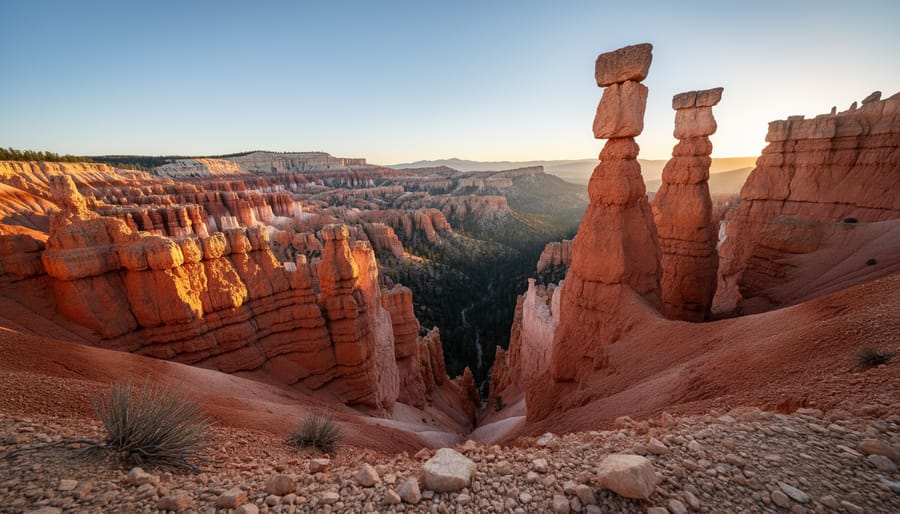
Bryce Canyon National Park sits just four hours south of Salt Lake City in southern Utah, and for Colorado adventurers already comfortable at elevation, it offers something genuinely otherworldly: thousands of crimson-orange spires called hoodoos rising from natural amphitheaters at 8,000 to 9,000 feet. The park is open 24 hours daily year-round with no advance reservations required, making it an accessible addition to any Southwest road trip from the Front Range or Western Slope.
What sets Bryce apart from other canyon systems isn’t its size (it’s actually quite compact at 35,835 acres) but its density of geological drama. The hoodoos, carved by freeze-thaw cycles and erosion over millions of years, create a landscape that shifts from alien to cathedral-like depending on the light. Sunrise and sunset transform the rock formations into glowing towers, and the 7.4-magnitude dark sky here rivals anything you’ll find in Colorado’s high country.
From a Colorado perspective, Bryce feels both familiar and startlingly different. The high-desert air and pine forests echo home, but the geology is pure fantasy. Most visitors from our state appreciate that the park’s main viewpoints are accessible from the rim road, while the trails down into the amphitheater (Queen’s Garden and Navajo Loop are classics) offer that hands-on adventure we crave. The park shuttle runs April through October 20, and while winter brings potential road closures after snowstorms, it also means fewer crowds and those hoodoos dusted in white.
Whether you’re planning a long weekend escape or linking Bryce with Zion and Capitol Reef for a Utah parks circuit, this is the kind of place that recalibrates your sense of scale and possibility.
What Makes Bryce Canyon Different from Colorado’s Parks
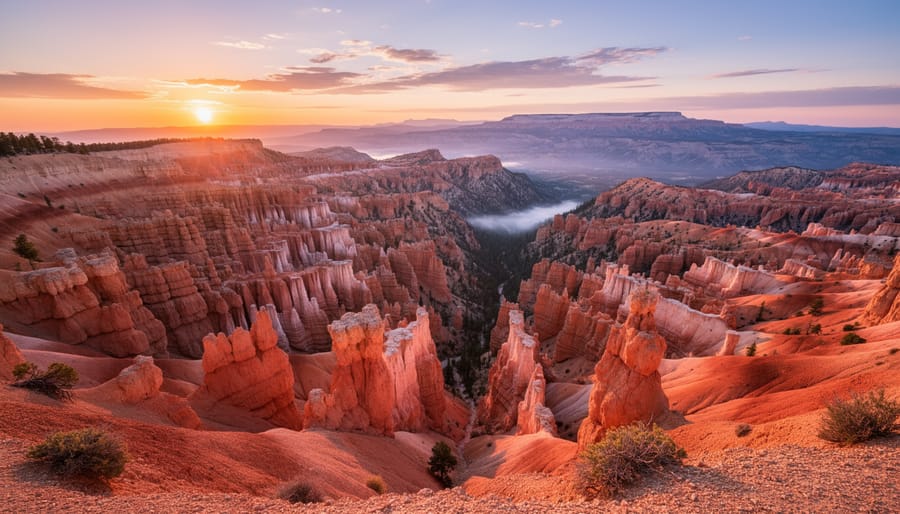
If you’ve explored Colorado’s towering peaks and alpine forests, Bryce Canyon will feel like stepping onto another planet. While the Rockies showcase granite spires and evergreen-clad slopes, Bryce presents a landscape carved from layers of orange, red, and cream-colored limestone. The park sits at elevations between 8,000 and 9,000 feet, comparable to many Colorado mountain towns, but everything else differs dramatically.
The defining feature here is the hoodoos: slender rock spires that rise like chess pieces from the canyon floor. These formations don’t exist anywhere in Colorado’s parks. Created through freeze-thaw cycles that crack the soft Claron Formation limestone, then shaped by rain and wind into impossibly tall, thin pillars, hoodoos cluster together in vast amphitheaters that stretch as far as you can see. Bryce Amphitheater alone contains thousands of these formations, creating a cityscape of stone that shifts color throughout the day.
Colorado’s red rock formations at Garden of the Gods or the canyons near Grand Junction feature solid walls and balanced rocks, but they lack this intricate erosion pattern. Bryce’s rock is younger and softer, allowing water to carve with surgical precision. The result is a forest of stone that invites you to walk among the formations rather than simply view them from overlooks.
The landscape also shifts your perspective on scale. In Rocky Mountain National Park, you look up at massive peaks. At Bryce, you stand on the rim looking down into amphitheaters where those hoodoos, some reaching 200 feet tall, appear tiny from above. Descend below the rim on a trail, and you’re suddenly dwarfed by walls of stone towering overhead. This flip in perspective, combined with the utterly different geology, makes Bryce an essential complement to what Colorado adventurers already know and love.
Planning Your Visit: What Colorado Travelers Need to Know
Getting There from Colorado
From Colorado, Bryce Canyon sits roughly 550 miles southwest, making it an ideal addition to a multi-day national parks road trip through the Southwest. The most direct route from Denver takes you through Grand Junction and into Utah, following I-70 West to US-50, then connecting to I-15 South near Salina before heading east on UT-20 and UT-12. Expect around eight to nine hours of drive time, though you’ll want to build in extra time for stops along the spectacular route.
From Colorado Springs, the journey runs similar in distance but follows I-25 South through New Mexico before cutting west. Durango and southwestern Colorado travelers have a shorter shot, coming in around six hours via US-491 and US-191 through Monticello.
The drive itself rewards you with changing landscapes: Colorado’s mountains give way to red rock desert country, then high plateaus dotted with juniper and pine. Highway 12, the final stretch into Bryce, ranks among America’s most scenic drives, winding through slickrock canyons and offering your first glimpses of southern Utah’s distinctive geology. Pack snacks and keep your gas tank above half once you leave I-15, as services thin out considerably in rural Utah.
When to Visit from a Colorado Perspective
If you’re used to Colorado’s seasonal rhythms, you’ll find Bryce Canyon’s climate refreshingly similar, but with a few twists worth noting. Spring (April through May) and fall (September through October) offer the ideal conditions for making the trip, with daytime temperatures in the 50s to 70s and smaller crowds than summer. These shoulder seasons mirror Colorado’s best hiking weather, making them natural choices for your visit.
Summer brings the biggest crowds and afternoon thunderstorms you’ll recognize from Rocky Mountain afternoons. Temperatures at the rim hover in the 70s and 80s, comfortable for hiking but busy enough that you’ll want to arrive early. The park shuttle runs from April to October 20, handling the summer traffic flow much like Colorado’s popular trailhead systems.
Winter transforms Bryce into a stunning but challenging destination. Snow drapes the hoodoos in white, creating otherworldly landscapes that rival anything you’ve seen in the Rockies. However, temporary winter road closures can happen after snowstorms, sometimes lasting several days until plows clear the routes. Colorado drivers familiar with winter driving safety will appreciate having those skills, and reviewing dangerous roads tips before attempting a winter trip proves valuable.
One advantage: Bryce sits at 8,000 to 9,000 feet, elevations Colorado residents handle without the altitude adjustment lowlanders need.
Top Experiences You Can’t Miss
Iconic Viewpoints and Rim Walks
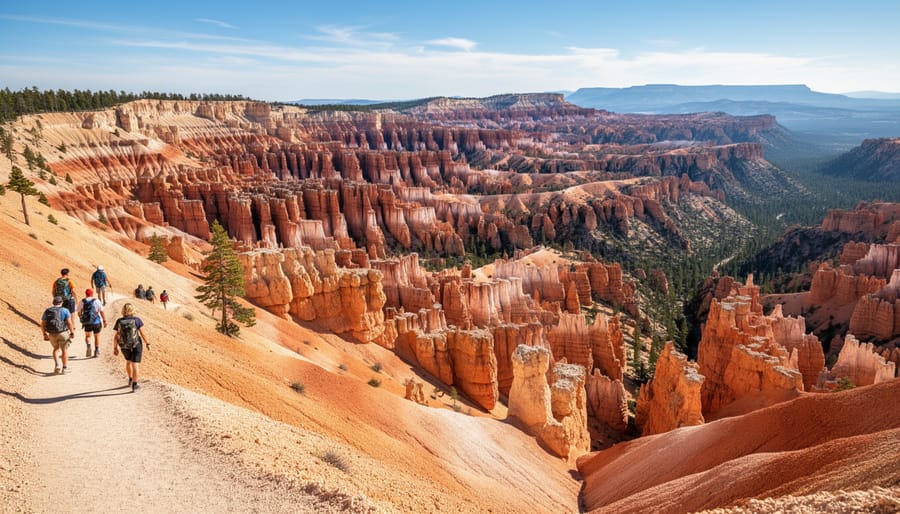
The rim trail at Bryce Canyon offers something Colorado hikers rarely encounter at home: a mostly flat walk with continuously jaw-dropping views. Unlike the steep, lung-burning ascents common in the Rockies, you can stroll along the canyon edge and let the landscape do the heavy lifting.
Start at Sunrise Point if you’re driving yourself, or hop the shuttle during its April to October 20 season to hit multiple viewpoints without moving your car. The paved path between Sunrise and Sunset Points spans just under a mile each way, easier than walking around City Park in Denver, yet the scenery shifts with every few steps. You’ll see hoodoos catching morning light, shadows deepening the amphitheater, and rock formations that look carved by a sculptor who got bored halfway through and decided to get weird with it.
Inspiration Point sits a short walk from the main trail and rewards the small detour with a three-tiered overlook. The upper viewpoint provides the most expansive perspective of the Silent City, a cluster of hoodoos that genuinely resembles ancient ruins. If you’ve hiked Colorado’s Barr Trail or tackled any fourteener, this qualifies as recovery-day terrain.
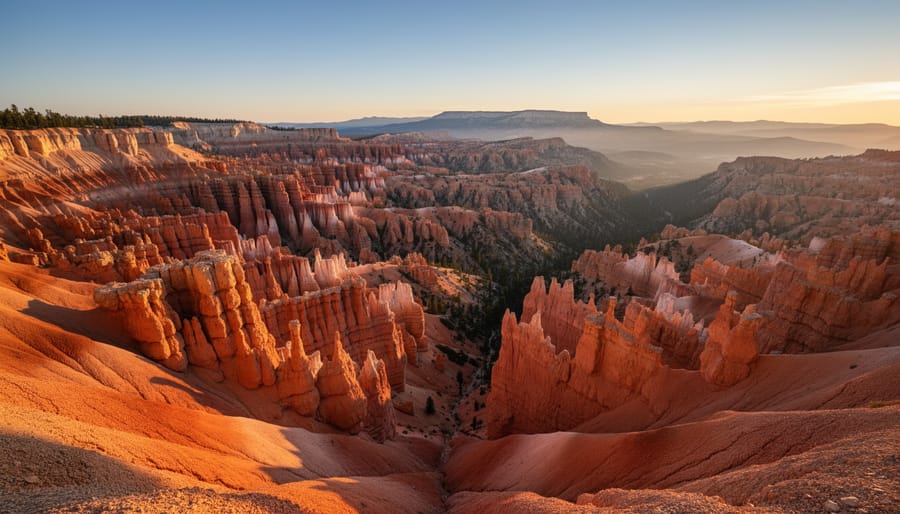
Bryce Point, positioned at the southern end of the amphitheater, delivers sunrise views that rival anything you’ve seen in the Rockies, minus the 3 a.m. alpine start. The viewpoint sits at 8,300 feet, comparable to many Colorado trailheads, so altitude shouldn’t slow you down. Just remember the park’s Stage 2 Fire Restrictions mean no campfires, even if those orange-red formations look ready to ignite on their own.
Hiking Among the Hoodoos
Walking below the rim at Bryce Canyon delivers an entirely different experience than viewing the hoodoos from above. These descents into the amphitheater place you directly among the towering spires, where you can appreciate their scale and intricate details up close.
The Navajo Loop Trail stands as the classic introduction to below-rim hiking. This 1.3-mile loop drops 550 feet through Wall Street, a narrow slot canyon flanked by soaring walls and Douglas firs. The steep switchbacks demand respect, but Colorado hikers familiar with altitude will find the elevation change manageable. For a trail difficulty comparison think of it as more strenuous than Garden of the Gods but shorter than most Colorado fourteener approaches.
Queens Garden Trail offers the gentlest descent into the hoodoos, dropping just 320 feet over 1.8 miles. Families and those wanting a less demanding option will appreciate the gradual grade and whimsical rock formations, including the Queen Victoria spire that gives the trail its name.
Combining Navajo Loop with Queens Garden creates the park’s most popular figure-eight route at three miles. This combination lets you experience two distinct canyon environments without retracing your steps. Start early before the shuttle crowds arrive, especially during summer months.
The Peek-a-boo Loop extends the adventure to 5.5 miles with more solitude and dramatic formations. Its sustained climbs and technical sections suit experienced Colorado hikers seeking a half-day challenge among the hoodoos.
Where to Stay and Nearby Adventures
For Colorado travelers accustomed to staying in Estes Park or mountain gateway towns, the area around Bryce Canyon offers a different vibe. The tiny town of Bryce Canyon City sits right outside the park entrance, hosting several lodges, motels, and cabins that range from budget-friendly to mid-range comfort. Most properties here are independently owned, giving you that authentic small-town Utah experience rather than chain hotel predictability.
If you prefer more dining and lodging variety, Tropic (11 miles east) and Panguitch (24 miles northwest) provide additional options and a glimpse into rural Utah life. Both towns feature local restaurants, grocery stores for trail snacks, and that slower pace Colorado mountain town lovers appreciate. Camping inside the park at North or Sunset Campground puts you steps from the rim, though sites fill quickly during peak season.
The real magic happens when you expand your Utah adventure beyond Bryce. The park sits perfectly positioned for a grand circle tour hitting several of the best national parks in the Southwest. Zion National Park lies just 80 miles southwest, offering dramatic canyon scenery that contrasts beautifully with Bryce’s high-elevation amphitheaters. Grand Staircase-Escalante National Monument borders Bryce to the east, perfect for backcountry explorers seeking solitude.
Capitol Reef National Park sits two hours northeast, while Grand Canyon’s North Rim (less crowded than the South Rim) is roughly three hours away. Many Colorado travelers turn this into a week-long loop, camping or hotel-hopping between parks. The drives between destinations rival Colorado’s scenic byways, winding through red rock country and high desert landscapes you won’t find back home. Pack extra memory cards, because the scenery between parks deserves as much attention as the destinations themselves.
Insider Tips from Travelers Who’ve Made the Trip
Colorado travelers who’ve made the journey to Bryce Canyon consistently share a few crucial insights that can make or break your visit. The single biggest tip: arrive at sunrise viewpoints by 5:30 AM during peak season to beat tour buses and have the hoodoos practically to yourself. Those golden morning hours also deliver the best photography lighting, with the red rocks glowing orange and pink in ways that rival anything you’ll capture at Garden of the Gods.
Pack more sun protection than you’d typically bring on Colorado hikes. The high-desert environment means stronger UV exposure, so experienced visitors recommend SPF 50, a wide-brimmed hat, and lightweight long sleeves even in moderate temperatures. Several travelers mentioned getting unexpectedly sunburned despite being accustomed to Colorado’s high altitude.
The most common mistake Colorado adventurers make is underestimating the below-rim hikes. What looks like a moderate two-mile trail becomes significantly harder on the steep, sandy return climb out of the amphitheater. Start early and allow double the time you’d budget for a similar elevation gain back home.
For crowd avoidance beyond sunrise, hit the most popular trails like Navajo Loop and Queen’s Garden after 4 PM when tour groups have departed. Late afternoon also brings cooler temperatures for those strenuous uphill sections. Pack hiking poles if you have wonky knees, the descents are steeper and more jarring than most Colorado trails, and poles make a noticeable difference on the return climb through loose sand and switchbacks.
Common Questions Colorado Travelers Ask About Bryce Canyon
Colorado travelers often have specific questions before making the trip to Bryce Canyon, especially since most of us are used to our own state’s incredible outdoor offerings. Here’s what you need to know before heading out.
How far is Bryce Canyon from major Colorado cities?
From Denver, expect about 7.5 to 8 hours of driving (around 500 miles), while Colorado Springs adds roughly 30-45 minutes to that time. The drive itself is scenic once you cross into Utah, making it a manageable weekend trip or the start of a longer southwestern adventure.
Do I need reservations to visit Bryce Canyon?
No advanced reservations are required to enter Bryce Canyon National Park. Simply present your Annual, Access, or Lifetime Pass or pay the park admission fee when you arrive, and you’re good to go 24 hours a day throughout the year.
How does Bryce Canyon compare to Colorado parks like Garden of the Gods?
While Garden of the Gods features dramatic red rock fins and balanced rocks, Bryce’s hoodoos are far more densely packed and create an otherworldly amphitheater effect you won’t find in Colorado. The scale and concentration of formations at Bryce offer a completely different visual experience from anything in our state.
Is Bryce Canyon good for families with kids?
Absolutely. The rim trail is stroller-accessible in many sections, and short below-rim trails like the Navajo Loop let kids experience the hoodoos up close without committing to an all-day hike. Most families find it more manageable than some of Colorado’s higher-elevation trails.
Winter visits are definitely possible, though keep in mind there may be temporary road closures during and after snowstorms. The park shuttle runs from April to October 20, so outside those months you’ll be driving yourself to viewpoints. Currently, Bryce Canyon is under Stage 2 Fire Restrictions, so check current conditions before your trip and plan accordingly. The elevation is similar to what we’re used to in Colorado, sitting around 8,000 to 9,000 feet, so altitude adjustment shouldn’t be an issue for most Colorado residents.
Bryce Canyon National Park stands as proof that some of the most rewarding adventures lie just beyond our own backyard. For Colorado travelers accustomed to dramatic peaks and alpine landscapes, the otherworldly hoodoos and red rock amphitheaters of southern Utah offer a refreshing contrast that’s absolutely worth the drive.
Whether you tackle it as a weekend escape from Denver or weave it into a longer southwestern road trip, Bryce delivers experiences you simply can’t find in the Rockies. The accessibility, the jaw-dropping geology, and the relatively uncrowded trails make it an ideal next chapter in your exploration story.
We’d love to hear about your Bryce Canyon adventures. What surprised you most about the park? Which trails became your favorites? Did you discover any hidden viewpoints or local spots that made your trip special? Share your experiences, tips, and photos with the Nomadic Adventures community. Your insights help fellow Colorado explorers plan their own Utah adventures and remind us all that the best discoveries often happen when we venture beyond familiar territory.